Hot Stamping vs Cold Foil on Labels: Differences, Cost Drivers and When to Use Each
This guide explains each process, compares them in one table and ends with what to send a manufacturer so the job can be quoted.
ETALEX has manufactured printed labels and tags in Cairo since 1952, and hot stamping is one of the in-house processes listed on our site, alongside letterpress, rotary offset, flexography, silk screen and digital printing.
What is hot foil stamping?
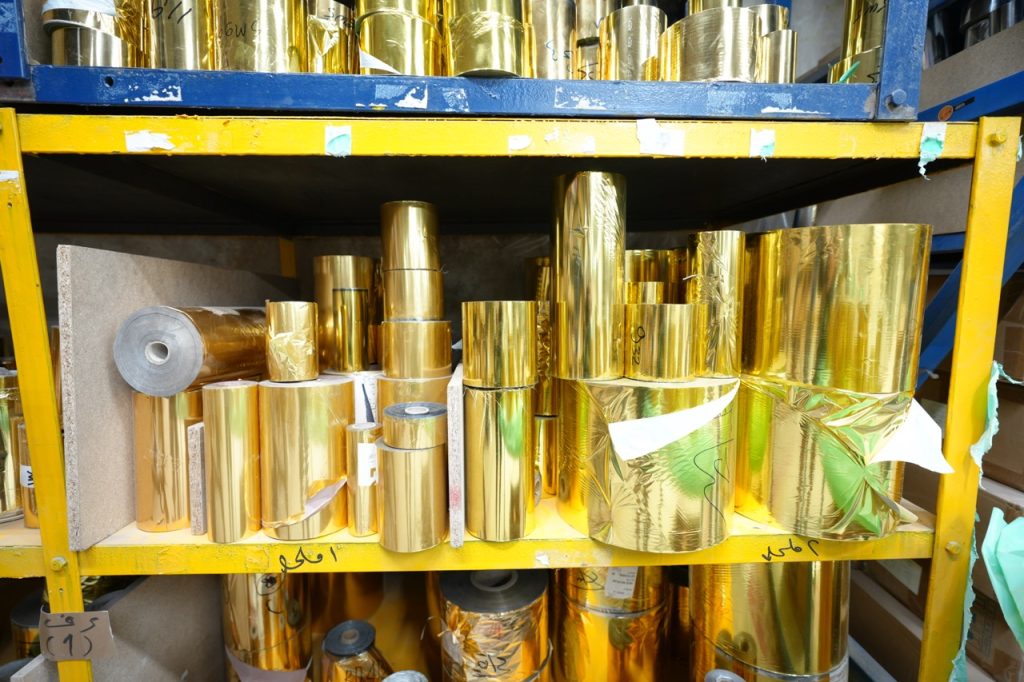
Hot foil stamping is a label finishing process that uses a heated metal die to press a foil ribbon onto the label surface. Heat activates the adhesive layer on the foil, pressure transfers the metallic layer, and only the areas the die touches receive foil. It is used for logos, lettering and borders.
The die is made for each design, commonly in magnesium, copper or brass. On a label press the hot foil unit may be flatbed, semi-rotary or fully rotary, and it can sit inline with printing or run as a separate pass. The roughness and other characteristics of the paper surface are among the criteria used to set the stamping adjustments (KURZ).
The same die principle allows foil and embossing in one step: a combination die stamps the foil and raises it at the same time against a matching counter.
What is cold foil?
Cold foil (also called cold transfer) is an inline label printing process that prints a UV-curable adhesive in the shape of the design, laminates a foil web against it and cures the adhesive, so foil stays only where adhesive was printed. No heated die is used; the image is carried by an ordinary printing plate.
The adhesive is applied by a print station on the press, most often flexo on narrow-web label presses, and the waste foil is rewound after transfer (Wikipedia, Cold foil printing; KURZ). Because the foil sits in the print sequence, it can be overprinted with process or spot inks. That lets a single silver foil produce many metallic colours, and it allows fine screens, gradients and halftones that a hot foil die cannot normally reproduce.
The trade-offs: cold foil gives its best results on smooth, coated papers and non-absorbent films, and some substrates are unsuitable for it (Wikipedia, Cold foil printing; KURZ). It adds no relief, and it is often protected with a varnish or laminate; how much depends on the foil, stock and handling.
Hot stamping vs cold foil: how do they compare?
The two processes differ mainly in tooling, the detail they can hold and the substrates they suit. Hot foil uses a heated die and gives high gloss, alone or with embossing; cold foil uses a printing plate and becomes part of the print. The table compares them on the same attributes. Exact limits depend on the press, foil and stock.
| Attribute | Hot foil stamping | Cold foil |
|---|---|---|
| How foil is bonded | Heated die and pressure activate the adhesive on the foil | UV-curable adhesive printed by a plate, foil laminated and cured inline |
| Finish | High gloss and metallic effects; stamping settings adjusted to the paper’s surface; can be combined with embossing for a tactile effect | Best results on smooth coated papers and non-absorbent films; some substrates unsuitable; flat, no relief on its own |
| Detail | Sharp edges on text, logos and solids; very fine halftones are difficult | Fine lines, screens, gradients and halftones possible; overprinting creates coloured metallics |
| Materials | Wide range of papers and many films; heat-sensitive films need care and testing | Best on smooth, non-absorbent surfaces; suits heat-sensitive films because no heat is applied |
| Tooling | Metal die per design (magnesium, copper or brass); combination die for foil plus emboss | Standard printing plate for the adhesive, as for an ink colour |
| Speed | Usually slower than the printing stations; dwell time for heat transfer limits speed | Runs inline at or near press speed |
| Cost drivers | Die cost, make-ready, slower running speed, foil usage (reduced by foil-saving systems) | Plate cost, need for a press with a cold foil unit, foil web usage across the run, adhesive, and any protective varnish or laminate |
| Typical uses | Premium logos, wine and spirits, cosmetics, perfume, foil with emboss, short and medium runs | Metallic effects within the artwork, longer runs, film labels, multi-colour metallics |
Sources: Wikipedia, Cold foil printing; KURZ Graphics (see Sources).
Which costs more, hot foil or cold foil?
Neither is always cheaper. Hot foil carries a die cost and usually runs slower, so it tends to suit short and medium runs or designs that need relief. Cold foil avoids a heated die and runs at press speed, so it tends to gain as runs lengthen. The deciding factors are tooling, run length, set-up, foil usage and speed.
Look at each driver for your job:
- Tooling and dies. Hot foil needs a metal die for every design, and a combination die if you add embossing. Cold foil needs one more printing plate. Dies can often be reused for repeat orders.
- Run length. Fixed costs such as dies, plates and make-ready are spread over the quantity. The longer the run, the less those costs matter per label.
- Set-up. Hot foil needs temperature, pressure and dwell set; cold foil needs adhesive, lamination and curing set. Both add make-ready time and waste, and a varnish over cold foil adds a step.
- Foil usage. Foil is consumed in widths and lengths, not only in the printed area. Small, scattered foil elements can waste foil on either process unless the press has a foil-saving or indexing system.
- Speed. Hot foil is often the slower station; cold foil normally keeps pace with printing.
Which suits cosmetic and perfume labels?
Both are used on cosmetic and perfume labels. Hot foil is often chosen for small logos, fine lettering and foil with embossing, where touch and shine matter. Cold foil suits metallic areas built into the artwork, gradients and coloured metallics, especially on film labels and longer runs. The stock, the container and handling decide the rest.
Questions to settle before choosing:
- Effect. A raised, tactile logo points to hot foil with emboss; a metallic gradient or several metallic colours point to cold foil.
- Facestock. Cold foil needs a smooth, non-absorbent surface, so textured or uncoated papers often point to hot foil; films, including heat-sensitive ones, often favour cold foil.
- Handling. Creams, oils and alcohol can attack a finish, and small squeezable bottles bend the label. Test rub resistance on the real stock and container.
For finishes, materials and durability across the category, see our page on cosmetics and beauty labels.
Can foil be combined with embossing?
Yes. With hot foil, a combination die can stamp and emboss in one pass, so the foil and the relief register exactly. Cold foil adds no relief itself, so embossing it means a separate embossing step with its own tooling, registered to the foil. Both routes add tooling, so confirm feasibility on your artwork early.
Points to check:
- Registration. Fine foil lines next to an emboss need tight register, so leave tolerance in the artwork.
- Stock. Thicker, softer papers usually emboss with more depth than thin films.
- Blind or registered. Blind embossing has no ink or foil; registered embossing aligns relief with print or foil.
What do I send to get a foil label quoted?
Send the artwork with the foil on its own layer, the label size, quantity and repeat orders, the facestock or container, the foil colour or effect, and whether you want embossing. Add how the product is used and stored. With this, a manufacturer can choose the process and price the tooling.
A practical checklist:
- Artwork as vector files, with foil areas on a separate spot layer named “foil”, and any emboss on another layer.
- Label size, shape and quantity, plus expected repeat orders (dies can be reused).
- Material if known, or the container type and surface.
- Foil colour or effect, with a physical reference if you have one.
- Conditions of use: moisture, oils, alcohol, refrigeration, abrasion.
Frequently asked questions
Is cold foil cheaper than hot foil? It depends on the job. Cold foil avoids a heated die and runs at press speed, which tends to help on longer runs. Hot foil carries die cost and slower running but needs no special cold foil unit and suits short runs with relief. Compare quotes on your own artwork, quantity and material rather than relying on a general rule.
Which gives finer detail, hot or cold foil? Cold foil generally holds finer screens, gradients and halftones because the adhesive is printed like ink. Hot foil gives crisp edges on text, logos and solids, but very fine halftones are difficult with a die. For very small text in either process, ask the manufacturer for the minimum line weight on your chosen stock.
Can cold foil be used on any facestock? No. Cold foil gives its best results on smooth, coated papers and non-absorbent films, and some substrates are unsuitable for it. Because no heat is used, it suits many heat-sensitive films. Test the exact material, adhesive and protective varnish before committing to a long run.
Can you print over foil? Over cold foil, yes: overprinting with process or spot inks is a common way to create coloured metallics from silver foil. Hot foil is usually applied after printing, so it sits on top. Overprinting hot foil is possible in some set-ups but depends on the foil’s printability and the press sequence, so confirm it first.
Sources
- Wikipedia, “Cold foil printing”. https://en.wikipedia.org/wiki/Cold_foil_printing. Accessed 4 October 2026. Used for: cold foil process steps, no stamping die, gradients and halftones, suitability for heat-sensitive films, best results on smooth coated stocks.
- KURZ Graphics, “What is hot stamping? FAQ”. https://www.kurz-graphics.com/en/hot-stamping/faq-hot-stamping/. Accessed 4 October 2026. Used for: hot stamping as transfer by heated die and pressure; brass dies; temperature and dwell; substrate roughness as a criterion for stamping adjustments; hot stamping vs embossing.
- KURZ Graphics, “Cold transfer for web-fed”. https://www.kurz-graphics.com/en/cold-transfer/web-fed/. Accessed 4 October 2026. Used for: cold transfer on narrow-web flexo without stamping dies; suitable substrates (PE, PP and PET films, papers with non-absorbent surfaces).
- ETALEX Contact page. https://www.etalex.com/contact/. Accessed 4 October 2026. Used for: phone, mobile, WhatsApp, email and working hours in the closing CTA.
Written by
Etalex Team
Content & Editorial Team
Practical guidance on label printing, finishing, materials and packaging, informed by Etalex's manufacturing experience in Cairo since 1952.
Related guides
Guides
Labels for Small Bottles and Cylinders: Design and Application Tips
Key answer On small bottles and tight cylinders, labels tend to lift at the edges because the material wants to spring back flat. Choose a…
Industry Insights
Cosmetic and Perfume Labels: Finishes, Materials and Durability
Key answer A cosmetic or perfume label has to look premium and stay that way through handling, water and skin oils. Choose the look first…
Guides
Label Quote Checklist: What to Send Your Manufacturer
Key answer To get an accurate label quote, send the manufacturer the label size and shape, quantity per version, material or the conditions the label…
Talk to the Etalex team
Ready to discuss your labels?
Send the size, quantity, material, finish and container, with artwork if you have it. Our team in Cairo replies during working hours, Sunday to Thursday.