Labels for Small Bottles and Cylinders: Design and Application Tips
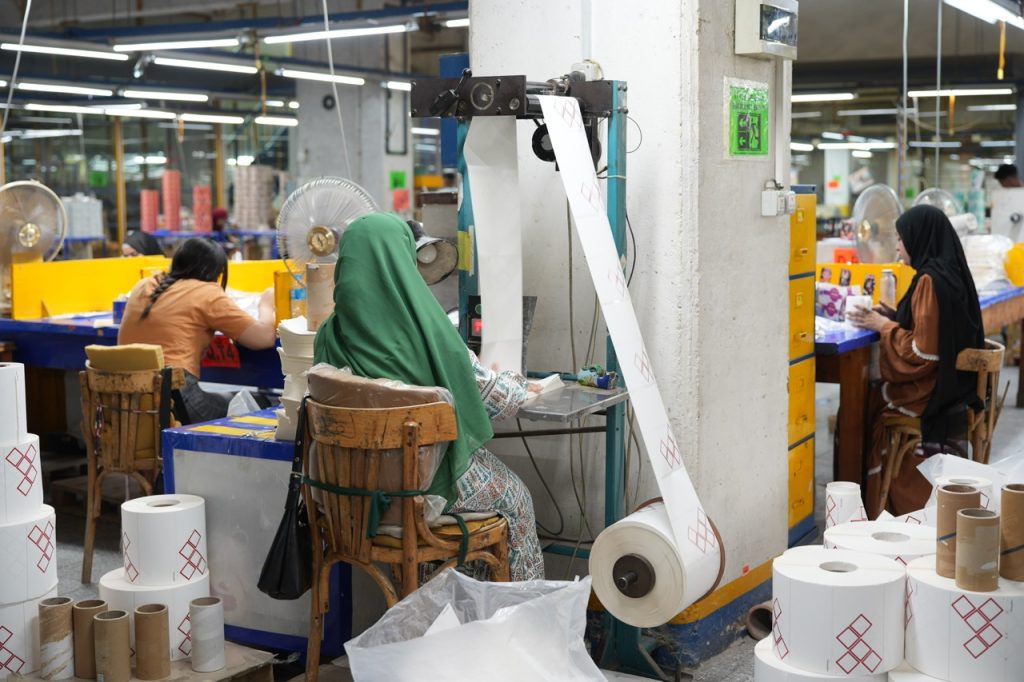
ETALEX has manufactured printed labels and tags in Cairo since 1952, including labels for lipsticks, eye-liners and other tight cylinders on our cosmetic labels page.
Why are small bottles and cylinders hard to label?
Small containers are hard to label because a label bent around a tight curve is under constant tension. HERMA, a label materials maker, describes “restorative forces” that act to lift a stiff or incorrectly applied label away from the surface. The smaller the diameter, the stronger that pull, so edges can lift, or “flag”, after application.
UPM Raflatac, a label materials supplier, adds further factors: label format, container material, surface treatments, chemicals, and temperature and moisture during application and storage. Squeezable bottles and tubes also flex in use, which a rigid label cannot follow.
How should you design a label for a small bottle?
Design for the wrap, not the flat sheet. On a small cylinder only part of the label faces the viewer at any time, so place the brand name and key information where they will be seen. Keep text and logos away from the overlap and seam, and agree the flat layout with your manufacturer before finishing the artwork.
Practical design points:
- Plan the front panel. Decide which part of the label faces forward on the shelf.
- Allow for the overlap. The overlap area is covered by the other end of the label, so keep text and codes out of it.
- Watch thick finishes. Stiffness rises with thickness (Avery Dennison), so heavy laminates or deep relief make a label harder to hold on a tight curve. Trial these on the real container. For finishes on cosmetics, see our planned guide to cosmetic and perfume labels.
- Tapered containers need a shaped label. A rectangular label on a tapered pot or bottle can sit crooked or crease. Label printer Sttark explains that the label is laid out as an arc, calculated from the top and bottom measurements of the container.
- Check small text. Small containers mean small labels; agree minimum text sizes early. See our label printing technologies for how fine detail is printed.
Before you send artwork, our planned label artwork checklist covers common file mistakes.
Which label materials work on small and curved containers?
Thin, flexible constructions work best. Avery Dennison’s facestock guide says any container that is squeezable, has a “waist” or is egg-shaped needs a conformable film, that tubes are labelled “always with a conformable film”, and that polyethylene (PE), the most conformable film, is often used on curved containers. Rigid films suit non-squeezable containers with flat label areas.
The same guide explains why: stiffness is set by a film’s thickness and rigidity. Biaxially oriented polypropylene (BOPP) is rigid and dispenses well but conforms poorly; PE is soft and very conformable but harder to convert; machine-direction oriented (MDO) films combine conformability with good dispensing.
For small diameters, UPM Raflatac notes that you may need “special, thin papers and very conformable, flexible films”, and HERMA pairs a supple, flexible face material with a matched high-tack adhesive. For products used in bathrooms or with oily hands, polypropylene (PP) labels are waterproof and oil resistant (ETALEX cosmetics page). Our guide to self-adhesive label materials explains facestock, adhesive and liner in more depth.
How do you stop labels lifting on small cylinders?
Treat edge lift as a construction problem, not only an adhesive problem. UPM Raflatac says the whole label combination works together and calls it “a common misconception” that simply changing the adhesive will solve edge lift. Combine a flexible face material, a matched adhesive and, where the design allows, ends that overlap so the label sticks to itself.
ETALEX’s approach for lipsticks and eye-liners follows the same logic: material with a lighter face coat and overlapping edges, both of which help prevent flagging (ETALEX cosmetics page).
Test before you approve: apply finished labels to real containers, store some in the heat, humidity or cold the product will meet, and recheck the edges (UPM Raflatac notes that application and storage conditions affect the result).
How are labels applied to small bottles and cylinders?
Labels for small cylinders are usually applied as wrap-around labels by machines that roll the container as the label goes on. Equipment makers offer dedicated systems for small items: Quadrel builds one for lipstick, lip balm, mascara and cosmetic pencils, and Race Label offers an attachment for small vials and lip balms that standard set-ups cannot handle.
Because the application method affects which materials dispense well, tell your label manufacturer whether labels go on by hand or by machine, and which machine. Our self-adhesive labels page shows the label types we supply on rolls.
What should change for each container shape?
Each container shape changes the label shape, the material and the layout. Use the table as a starting point for the conversation with your manufacturer; it is qualitative, and the right construction depends on the container, the product and the application method, so test it on your real packs.
| Container | Label design considerations | Material considerations |
|---|---|---|
| Tight rigid cylinder (lipstick, eye-liner, pen, vial) | Wrap-around layout; front panel planned; overlap kept clear of text and codes | Thin, flexible construction; lighter face coat; adhesive for tight curves |
| Small rigid round bottle | Decide wrap or front-only label; keep labels within the flat, labelable zone | Conformable film helps on curves; rigid films where the area is flat |
| Squeezable bottle or tube | Allow for the pack flexing in use | Conformable film; PE is the most conformable |
| Tapered pot or bottle | Arc-shaped label calculated from top and bottom measurements | Conformable films cope better with curves and shaped edges |
| Waisted or egg-shaped bottle | Agree the label position with your manufacturer before artwork | Conformable film required |
| Glass bottle with clear “no-label” look | Check legibility against the product colour | Conformable clear film gives high clarity without trapped air bubbles |
Sources: Avery Dennison; HERMA; UPM Raflatac; Sttark; ETALEX cosmetics page (see Sources).
What should you send your label manufacturer?
Send the container itself or a drawing, its diameter, height and material, the label size and position, how labels will be applied, and the conditions the product will meet.
- Container type, material and whether it is squeezable.
- Diameter, height and any taper, plus empty samples if possible.
- Label size, shape and the visible front panel.
- Application method and machine.
- Product contents and use: water, oils, alcohol, heat or cold, handling.
- Finishes wanted, such as foil, varnish, lamination or embossed labels.
- Quantity and number of versions.
Our label quote checklist covers the full specification, and how to choose a label manufacturer explains what to ask suppliers. Small vials and ampoules for medicines are covered on our pharmaceutical labels page.
Frequently asked questions
Why do labels peel off small bottles? On a tight curve the label material tries to spring back flat, and this pull acts on the edges. Stiff or thick labels, the wrong adhesive for the surface, and heat, cold or moisture can all make edges lift. A thin, conformable construction, a matched adhesive and an overlap that lets the label stick to itself reduce the risk.
What is the best label material for squeezable bottles? Squeezable containers need a conformable film that flexes with the bottle, according to Avery Dennison’s facestock guide. Polyethylene is the most conformable film and is often used for curved containers, while machine-direction oriented films combine conformability with good dispensing. Rigid films such as BOPP suit non-squeezable containers with flat label areas.
Should a wrap-around label overlap? Where the design allows, yes. An overlap lets the label stick to itself as well as to the container, which helps against edge lift on small diameters. Keep text, barcodes and batch codes out of the overlap zone, and agree its position with your manufacturer so the front panel faces forward on the shelf.
Can I use premium finishes on very small containers? Often, yes, but test them. Thick laminates and deep embossing add stiffness, which makes a label harder to hold on a tight curve. Apply finished samples to your real container and recheck the edges after storage. For finish options, see our printing and finishing services and ask which combination suits your container.
Sources
- ETALEX, Cosmetics page. https://www.etalex.com/cosmetics/. Accessed 5 October 2026. Used for: tight cylinders such as lipsticks and eye-liner; material with a lighter face coat and overlapping edges to prevent flagging; PP labels waterproof and oil resistant.
- ETALEX, About page. https://www.etalex.com/about/. Accessed 5 October 2026. Used for: established 1952; Cairo address; in-house processes (letterpress in flat and rotary, rotary offset, flexography, silk screen, digital printing, hot stamping).
- Avery Dennison (Ophelia Gallagher), “How to Choose the Right Film Facestock: Pressure Sensitive Label Application Decisions for the HPC, Food and Beer/Beverage Markets” (whitepaper, PDF). https://www.averydennison.com/content/dam/averydennison/lpm/ap/en_cn/doc/resourcecenter/HowtoChoosetheRightFilmFacestock.pdf. Accessed 5 October 2026. Used for: small diameter less than 1 inch as a selection question; squeezable, waisted or egg-shaped containers need conformable films; stiffness from thickness and modulus; BOPP, PE and MDO trade-offs; PE most conformable, used on curved containers; tubes always with a conformable film; conformable films better on ridges and shaped edges; conformable clear film on glass without trapped air bubbles; flat label area preferred.
- UPM Raflatac, “How to decrease the risk of label edge lifting on small diameter injectables containers”. https://www.upmraflatac.com/articles/raflatac/23/how-to-decrease-the-risk-of-label-edge-lifting-on-small-diameter-injectables-containers/. Accessed 5 October 2026. Used for: whole label combination works together; thin papers and very conformable films; overlap so the label sticks to itself; changing the adhesive alone a “common misconception”; factors including label format, container material, surface treatment, chemicals, temperature and moisture.
- HERMA, “Curved surface labelling: flexible labels for test tubes, drums and small radii”. https://www.herma.com/label/products/wrap-around-labelling/. Accessed 5 October 2026. Used for: restorative forces lifting stiff or incorrectly applied labels; supple flexible material with matched high-tack adhesive; wrap-around labels on test tubes, ampoules, pens, vials, syringes and cosmetic pencils.
- Quadrel, “Cosmetic Labeling Machines”. https://www.quadrel.com/cosmetic-labeling-machines/. Accessed 5 October 2026. Used for: dedicated wrap-around system for small diameter tubes such as lipstick, lip balm, mascara and cosmetic pencils.
- Race Label Solutions, “Lip Balm, Small Vial and Nesting Plate Attachments”. https://racelabel.com/lip-and-small-vial-attachment/. Accessed 5 October 2026. Used for: attachment added to a labelling machine to handle small vials, lip balms and small containers.
- Sttark, “How to Label a Tapered Container or Curved Surface”. https://www.sttark.com/blog/how-to-label-a-tapered-container-or-curved-surface. Accessed 5 October 2026. Used for: untapered labels on tapered containers appear crooked or crease; arc-shaped layout from top and bottom measurements.
Written by
Etalex Team
Content & Editorial Team
Practical guidance on label printing, finishing, materials and packaging, informed by Etalex's manufacturing experience in Cairo since 1952.
Related guides
Industry Insights
Motor Oil and Lubricant Labels: Oil Resistance and Adhesion on Plastic Containers
Key answer Motor oil labels fail mainly at the edges: plastic oil containers are hard surfaces for adhesives to grip, and oil on the pack…
Industry Insights
Chemical and Detergent Labels: Resistance to Moisture, Chemicals and Handling
Key answer A chemical or detergent label has to stay attached and readable while the product drips on it, the pack is handled wet and…
Industry Insights
Beverage and Water Bottle Labels: Wet Conditions, Condensation and Adhesion
Key answer Labels fail on beverage bottles mainly because cold bottles collect condensation, and a self-adhesive label will not stick to water. Keep the bottle…
Talk to the Etalex team
Ready to discuss your labels?
Send the size, quantity, material, finish and container, with artwork if you have it. Our team in Cairo replies during working hours, Sunday to Thursday.