How to Choose a Label Manufacturer: 12 Questions to Ask Before You Order
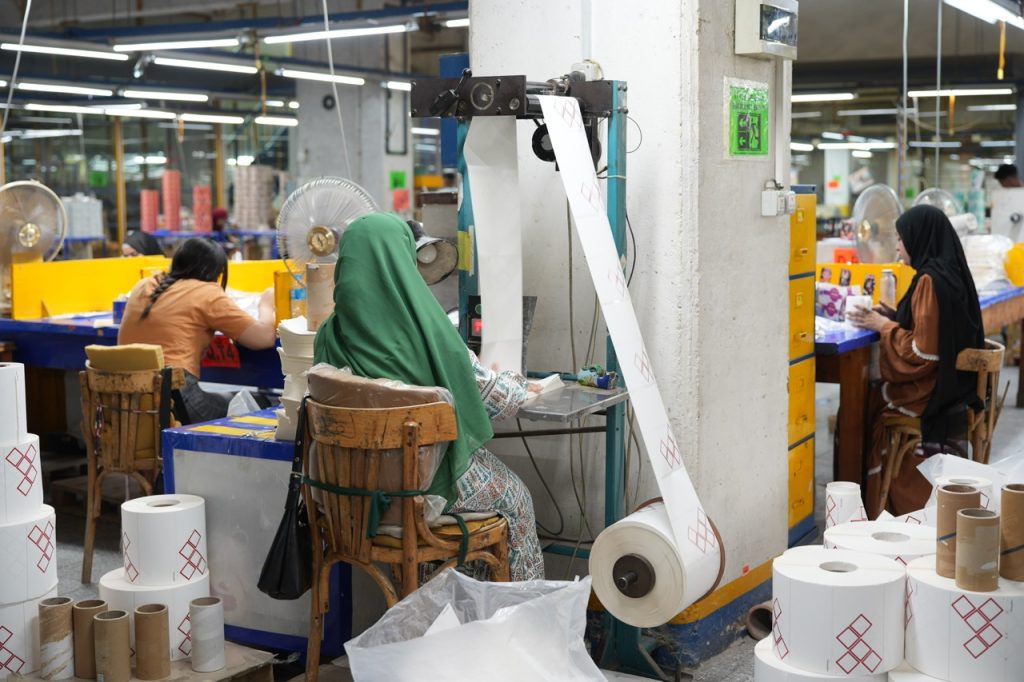
The questions below work with any supplier, local or overseas. Each comes with what a good answer looks like and the red flags to watch for. Use them in a call, a supplier questionnaire or a factory visit.
What should you prepare before you contact label manufacturers?
Prepare a short specification before you ask anyone for a price: label size and shape, quantity, the container and surface, the conditions the label must survive, the finish you want and your artwork status. Suppliers can only answer the questions below properly when they know what you are buying.
Our label quote checklist lists every field. Most buyers are sourcing self-adhesive labels, so several questions focus on materials and roll format. Send every supplier the same specification so the answers compare.
1. Do you print and finish the labels in your own factory?
Ask which steps happen in the supplier’s own plant and which are subcontracted. A manufacturer that prints, finishes and converts in-house controls quality and timing directly. A broker or a printer that sends finishing outside adds handovers, and each handover is a point where schedules slip and responsibility blurs.
- Good answer: a list of in-house steps (pre-press, printing, finishing, die-cutting, inspection) and a plain statement of anything outsourced.
- Red flag: “we work with partners” with no detail, or reluctance to let you visit.
2. Which printing processes do you run, and which would you use for my label?
A capable supplier names its processes and explains why one suits your job. Flexography, offset, letterpress, silk screen and digital printing each have strengths in detail, colour, run length and special effects. The right answer depends on your artwork and quantity, not on the one press a supplier happens to own.
- Good answer: a recommendation with a reason, tied to your quantity and artwork.
- Red flag: every job steered to the same process.
3. Which certificates do you hold, and are they current?
Ask for copies of each certificate, not a logo on a brochure. Check the issuing certification body, the registration number, the expiry date and, most important, the scope statement. The scope should name label design, printing or manufacture. A certificate that covers another activity or site tells you little.
- Good answer: copies shared readily, with a label-production scope. Common ones are ISO 9001 (quality), ISO 14001 (environment), ISO 45001 (health and safety), and GMP or HACCP for pharmaceutical and food supply chains.
- Red flag: expired dates, a scope that does not mention labels, or certificates “in progress” presented as held.
4. Have you made labels for my industry and container type?
Relevant experience shortens development. A supplier that already labels products like yours knows the common failure points, such as oily bottles, squeezable tubes, wet conditions or small vials. Ask what similar jobs it has produced, within the limits of client confidentiality, and how it solved them.
- Good answer: comparable examples, and questions back to you about how the product is used.
- Red flag: “we can do anything” with no example.
5. Which facestock, adhesive and liner would you recommend, and why?
A self-adhesive label is a system: the printed facestock, the adhesive and the release liner. The supplier should recommend each layer based on your container surface, application method, temperature, moisture, chemical contact and required life. The reason for each choice matters as much as the choice itself.
- Good answer: a recommendation tied to your conditions, with a data sheet on request.
- Red flag: one default material for every job.
6. Can I approve a proof or sample before the production run?
Yes, and you should insist on it. You need to see and sign off what will be printed before the run starts. Ask whether the proof is digital, printed or on the real material, and for difficult containers test sample labels on your own line first.
- Good answer: a defined proofing step with written sign-off, and test material where adhesion is a risk.
- Red flag: production starts on a verbal “looks fine”.
7. How do you control artwork versions and text changes?
Ask how the supplier makes sure the approved version, and only that version, goes to press. Look for version numbering and a signed approval record. This matters most for regulated text such as ingredients, dosage, batch fields and hazard statements, where printing an old revision can mean relabelling stock.
- Good answer: a documented approval process, version history per label, and withdrawal of old plates and files.
- Red flag: artwork handled by informal email with no version record.
8. How do you keep colours consistent from run to run?
Colour drift between batches is one of the most visible faults on a shelf. Ask how brand colours are matched (for example to Pantone references), how colour is checked on press, and whether an approved sample is kept as the reference for every repeat order.
- Good answer: a stated matching method, checks against a retained approved sample, and an agreed tolerance.
- Red flag: no retained reference from your first order.
9. What is your minimum order quantity, and how does price change with volume?
Minimum orders and price breaks should be stated plainly before you commit. Unit price usually falls as quantity rises because set-up, plates and tooling are spread over more labels. Ask which costs (plates, cutting dies, foil or embossing tools) apply only to the first order.
- Good answer: one-off costs shown separately from the unit price, with clear quantity breaks.
- Red flag: a low headline price with tooling or proofs added later.
10. What lead times should I plan for, for a first order and for repeats?
Ask for lead times counted from artwork approval, not from enquiry, and ask separately for first orders and repeat orders. First orders often take longer because of proofing, new plates and new tooling. Also ask what lengthens a lead time and how you will hear about a delay.
- Good answer: a range tied to specific steps, and a named contact who reports delays early.
- Red flag: a fast promise with no conditions attached.
11. How will the labels be supplied for my application method?
If labels go on an automatic applicator, the roll format must match the machine: core size, maximum roll diameter, labels per roll, winding direction and the gap between labels. A wrong winding direction can stop a filling line, so agree the format in writing before the order.
- Good answer: the supplier asks for applicator details before quoting and confirms the format on the order.
- Red flag: roll format is never discussed.
12. What happens if a delivery is wrong?
Ask how the supplier inspects finished labels, how it traces a batch back to its materials and run, and how it handles a complaint. You want to know before you need it who investigates, how quickly you receive an answer, and how replacement or credit is decided.
- Good answer: final inspection, batch traceability and a written corrective-action process.
- Red flag: no traceability.
How do you compare the answers from different manufacturers?
Score each supplier against the same questions and specification, and weight what matters for your product. A pharmaceutical buyer may weight certificates and artwork control highest; a cosmetics brand may weight finish and colour. Compare price only once the essential answers are acceptable, because a cheap quote with weak answers costs more later.
| Area | Questions | What to record |
|---|---|---|
| Capability | 1, 2, 4 | In-house steps, processes offered, relevant experience |
| Quality and compliance | 3, 7, 8, 12 | Certificates and scope, artwork control, colour method, complaint process |
| Fit for your product | 5, 6, 11 | Material recommendation, proof and sample route, roll format |
| Commercial terms | 9, 10 | MOQ, one-off costs, unit price breaks, lead times |
How does ETALEX answer these questions?
ETALEX has manufactured printed labels and tags in Cairo since 1952, when the company was founded by the Alexanian brothers. The processes listed on our site, run in-house, are letterpress, rotary offset, flexography, silk screen, digital printing and hot stamping. We supply pharmaceutical, cosmetics, food and beverage, detergents and cleaning, automotive oils and lubricants, and industrial and textile customers.
Our ISO 9001, GMP and HACCP certificates are published with their registration details, alongside ISO 14001:2015 and ISO 45001:2018. The certificates were issued by ABS Global on 17 May 2026 and are valid until 16 May 2027 as published; the ISO 9001:2015 registration is EGY985QMS. The certified scope reads: “design, pre-press, manufacture, printing, conversion, finishing, and supply of self-adhesive labels and specialty label solutions using flexographic, offset, screen, and digital printing processes”. ETALEX has been a Finat member since 2016.
Frequently asked questions
What is the most important question to ask a label manufacturer?
Ask what the supplier’s certificates cover and whether they are current. A valid certificate with a scope that names label production shows that an independent body audits its quality system. It does not replace the other questions, but a supplier that cannot show one needs closer checking before you place a regulated or high-volume order.
Should I choose a label supplier on price?
Compare price only after the essential answers are acceptable. A low unit price can hide one-off costs for plates and tooling, longer lead times or weaker artwork control. Ask every supplier to quote the same specification and to separate one-off costs from unit prices, so that you compare like with like.
Is a factory visit worth it before choosing a label supplier?
A visit is worth making for large, regulated or long-term contracts. You see the presses, the inspection steps and how artwork and materials are controlled, which is hard to judge from documents. If you cannot visit, ask for a video walk-through and copies of the relevant certificates and procedures instead.
What should I send a label manufacturer to get an accurate quote?
Send the label size and shape, quantity, material or the conditions it must survive, finishes, number of colours, container type, application method, roll format if machine-applied, and your artwork or its status. Our label quote checklist lists every field in one table that you can complete and send.
Sources
- ETALEX Certifications and Awards page, https://www.etalex.com/awards/ (certificate names, registration EGY985QMS, validity date, certified scope, Finat membership). Accessed 4 October 2026.
- ISO, ISO 9001:2015 Quality management systems, https://www.iso.org/standard/62085.html (definition of what the standard covers, for question 3).
- ISO pages for ISO 14001:2015 and ISO 45001:2018 (one-line description of each, for question 3).
- A source for verifying certificates through the certification or accreditation body (for example the IAF CertSearch database, https://www.iafcertsearch.org/), for question 3 and the FAQ. Confirm the database lists the relevant certification body before citing.
- Finat, https://www.finat.com/ (membership reference).
- Optional: a label materials supplier’s technical guide for the facestock, adhesive and liner explanation in question 5 and the roll-format terms in question 11.
- ETALEX Contact page, https://www.etalex.com/contact/ (phone, mobile, WhatsApp, email and working hours in the closing CTA). Accessed 4 October 2026.
No statistics are used in this article. If any are added in editing, each needs a cited source.
Written by
Etalex Team
Content & Editorial Team
Practical guidance on label printing, finishing, materials and packaging, informed by Etalex's manufacturing experience in Cairo since 1952.
Related guides
Industry Insights
Motor Oil and Lubricant Labels: Oil Resistance and Adhesion on Plastic Containers
Key answer Motor oil labels fail mainly at the edges: plastic oil containers are hard surfaces for adhesives to grip, and oil on the pack…
Industry Insights
Chemical and Detergent Labels: Resistance to Moisture, Chemicals and Handling
Key answer A chemical or detergent label has to stay attached and readable while the product drips on it, the pack is handled wet and…
Industry Insights
Beverage and Water Bottle Labels: Wet Conditions, Condensation and Adhesion
Key answer Labels fail on beverage bottles mainly because cold bottles collect condensation, and a self-adhesive label will not stick to water. Keep the bottle…
Talk to the Etalex team
Ready to discuss your labels?
Send the size, quantity, material, finish and container, with artwork if you have it. Our team in Cairo replies during working hours, Sunday to Thursday.