Self-Adhesive Label Materials: How to Choose Facestock, Adhesive and Liner
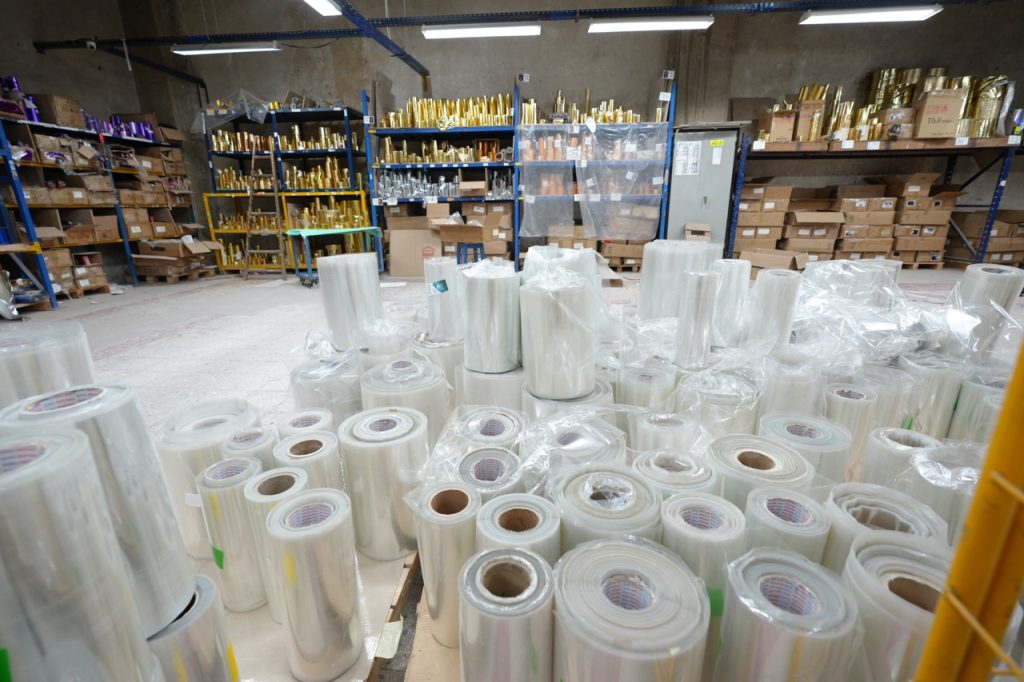
This guide explains each layer, the questions that drive the choice and a selection table to use as a starting point. It is vendor-neutral, built on published material-supplier guidance and FINAT test methods listed under Sources.
ETALEX has manufactured printed labels in Cairo since 1952. For self-adhesive labels we choose the face material and adhesive for the container and the contents, not the other way round.
What is a self-adhesive label made of?
A self-adhesive (pressure-sensitive) label is a laminate of three layers. The facestock is the printed paper or film. The adhesive bonds to the container when pressed on. The release liner, usually silicone-coated, protects the adhesive until the label is peeled off and applied by hand or machine.
Each layer affects performance, cost and waste; the liner alone can make up to 35% of the unprinted laminate, especially with thin facestocks (Avery Dennison, label liners white paper).
What do you need to know before choosing materials?
Answer five questions first: what the container is made of, its shape, the surface condition at labelling, what the label must survive, and how it will be applied. Suppliers build their recommendations from these answers, so collecting them early saves sampling rounds.
Avery Dennison’s selection questions make a useful checklist: Is the substrate HDPE, LDPE, PET, PP, glass or PVC? Flat, curved or small diameter? Rigid or squeezable? Is the surface textured, greasy or hot? Add application temperature, service conditions (moisture, cold chain, chemicals, oil, abrasion), required label life and the application method.
How do you choose the facestock?
Choose the facestock first for the conditions of use and container shape, then for appearance and printing. Paper suits dry conditions, rich finishing and cost-sensitive jobs. Film suits moisture, chemicals, squeezable containers and clear “no-label” looks. Within each family, coating, gloss and stiffness narrow the choice.
Paper facestocks
Suppliers point to paper’s textures and finishes, its suitability for hot-foil stamping and embossing, the option of varnish or lamination, and its cost. Coated papers carry a semi-gloss or gloss coating; uncoated papers do not. Properties to specify include weight, opacity, gloss, resistance to humidity, oil and grease, scuffing, and stiffness, which affects dispensing (Avery Dennison, paper materials guide).
Worked example: ETALEX’s published pharma papers. Our pharmaceutical label page names three paper facestocks, which show how coating and calendering (smoothing the paper between rollers) are used to tune finish:
| ETALEX name | Construction as published | Finish as published |
|---|---|---|
| Pharma Glossy | Cast-coated, uncalendered paper | Superior gloss |
| Pharma High-Gloss | Coated, calendered paper | Superior gloss |
| Pharma Semi-Glossy | Coated, super-calendered paper | Moderate gloss |
Film facestocks
Film facestocks are mostly polyethylene (PE), polypropylene (PP) and polyester (PET). Avery Dennison describes PE as the most conformable film, often used on curved containers; PP as one of the most rigid films, used where a stiff, clear label is needed; and PET as a highly durable, heat-resistant film for demanding high-heat applications. It adds that squeezable, “waisted” or egg-shaped containers require conformable films (Avery Dennison, How to Choose the Right Film Facestock).
Does the printing process affect the facestock?
Yes. Suppliers engineer stocks for specific printing technologies (Avery Dennison, paper materials guide), so confirm the stock suits the press. ETALEX runs letterpress, rotary offset, flexography, silk screen, digital printing and hot stamping in house; see label printing methods compared.
How do you choose the adhesive?
Choose the adhesive by function (permanent, removable or special), then by chemistry, then check it against the surface and temperatures. Permanent adhesives are not meant to come off; removable ones peel off cleanly; special grades cover freezer, wash-off and rough or contaminated surfaces. Most are acrylic or rubber based.
Permanent, removable, freezer and high-tack
- Permanent adhesives stay for the product’s life, from general purpose to “extra permanent” grades (Avery Dennison, adhesives overview).
- Removable adhesives release without residue, for temporary labels (HERMA). Temperature changes this: “A removable adhesive at room temperature is actually permanent at low temperature” (Avery Dennison, adhesive technologies guide).
- Freezer (deep-freeze) adhesives apply and hold at low temperatures. Each grade has its own minimum application temperature, and one supplier notes limited curved-surface performance for its acrylic freezer grade (Avery Dennison, adhesives overview).
- High-tack adhesives give strong initial grab for rough surfaces or tight curves (Avery Dennison, adhesives overview).
Acrylic or rubber-based?
Per Avery Dennison’s adhesive guide, emulsion acrylic suits high-speed conversion and is “an excellent choice for food contact”; hot-melt rubber gives tack on the broadest range of surfaces, the best low-temperature performance and good adhesion on rough or contaminated surfaces; solvent acrylic offers water, heat and chemical resistance. Hot-melt can have a yellowish tint, which matters on clear labels (Avery Dennison, film guide).
Match the adhesive to the surface
Glass, PET and metals are high-energy surfaces and easier to label; HDPE, PP, LDPE and PVC are low-energy and more challenging (Avery Dennison, adhesive technologies guide and film guide). Rough, dusty or oil-contaminated surfaces need adhesives designed for them.
Application temperature and service temperature
Application temperature is when the label goes on; service temperature is what it endures afterwards. Avery Dennison states that most of its own adhesives are designed for ambient application, with a minimum of +5°C, and survive service temperatures of -40°C to +80°C, with special grades beyond that. Other grades differ, so read the data sheet.
How do you choose the liner?
Choose the liner for how the labels will be converted and applied. Glassine (paper) and PET (film) are the most widely used release liners. Glassine suits the established base of equipment; PET liners are thinner and more consistent at high dispensing speeds, but not every machine was designed for filmic liners.
Compared with glassine, Avery Dennison lists for PET liners consistent performance at higher dispensing speeds, no web breaks even in wet conditions, less paper dust and better lay-flat (PET liners factsheet); its white paper adds that not all machines were built for filmic liners. HERMA notes glassine, kraft and PET liners all suit die-cutting and labelling machines. Ask which liner your applicator needs.
Material selection table: starting points by container and condition
These are general starting points from supplier guidance, not a specification. Confirm every combination by sampling on the real container and line.
| Container and surface | Conditions of use | Facestock to consider | Adhesive to consider | Liner to consider | What to test |
|---|---|---|---|---|---|
| Glass bottle or jar (high-energy, rigid) | Dry, ambient | Coated paper; PP or conformable clear film for a no-label look | General-purpose permanent | Glassine or PET, per applicator | Adhesion on the real bottle; clarity if clear-on-clear |
| Rigid PET bottle (high-energy) | Ambient; condensation if chilled | PP film | Permanent, chosen for wet or chilled application | PET where high-speed or wet dispensing | Adhesion after chilling and condensation |
| HDPE squeezable bottle or tube (low-energy) | Repeated squeezing; bathroom moisture | Conformable PE film | Permanent for low-energy plastics | Per applicator | Lifting and wrinkling after squeezing |
| Small-diameter vial or syringe | Tight curve | Conformable film | High-tack permanent; one supplier suggests a solvent adhesive for syringes | Per applicator | Mandrel hold (flagging on the curve) |
| Carton or corrugated board | Dry; rough or dusty surface | Paper | Permanent with high initial tack | Per applicator | Tack and fibre tear on the real board |
| Chilled or frozen food pack | Labelled cold, or frozen after labelling | Paper or PP film | Freezer grade with a stated minimum application temperature | PET if the line is wet | Low-temperature adhesion at the real application temperature |
| Detergent or chemical container | Splashes, wet handling, abrasion | Film, chosen by testing with the real contents | Permanent, tested with the contents | Per applicator | Chemical resistance with the real contents; rub resistance |
| Oil or lubricant container (HDPE, often oily) | Oil contact on the surface | Film, or paper specified for oil and grease resistance | Grade designed for oily or contaminated surfaces | Per applicator | Adhesion after oil exposure |
Sources: items 2, 4, 5, 7 and 9 below. Industry pages: food and beverage labels, cosmetics labels, detergent and cleaning product labels, automotive oil and lubricant labels.
How is a material choice confirmed before a full run?
Confirm it on the real container, at the real temperature, on the real line. Apply samples, age them in the expected conditions and check adhesion, lifting and print durability. Ask for material data sheets and which FINAT test methods (FTM) their figures use, so results can be compared.
FINAT’s Technical Handbook (11th edition) contains 31 test methods. Those most relevant here include FTM 1 and FTM 2 (peel adhesion at 180° and 90°), FTM 8 (resistance to shear), FTM 9 (loop tack), FTM 13 (low-temperature adhesion), FTM 16 and 17 (chemical resistance, spot and immersion) and FTM 24 (mandrel hold) (FINAT). Avery Dennison’s data, for example, reports tack by FTM 9 and peel by FTM 2, and it recommends testing the complete construction.
For food and medicines, confirm suitability for the specific adhesive and facestock from the supplier’s documents; Avery Dennison, for instance, offers low-migration adhesives for pharmaceutical use. For quality systems, see the Etalex certificates.
Frequently asked questions
What is the difference between permanent and removable label adhesive? A permanent adhesive is designed to stay on for the life of the product and usually cannot be removed cleanly. A removable adhesive is designed to peel off without leaving residue, for temporary labels. Temperature matters: one supplier notes that a removable adhesive at room temperature behaves as permanent at low temperature, so test in real conditions.
Should I choose a paper or a film label? Choose paper for dry conditions, textured or premium finishes and cost-sensitive jobs. Choose film when the label faces moisture, chemicals, abrasion or squeezing, or when you want a clear no-label look. Within film, PE suits squeezable containers, PP suits rigid ones and PET suits the harshest conditions. Confirm by testing on your container.
Why do labels lift or wrinkle on squeezable bottles? Usually because the facestock is too stiff to follow the container as it flexes, or the adhesive is not suited to a low-energy plastic such as HDPE. Supplier guidance is that squeezable, waisted or egg-shaped containers need a conformable film, such as PE, with an adhesive chosen for low-energy surfaces.
Sources
All accessed 5 October 2026.
- FINAT, “FINAT Test Methods”. https://www.finat.com/knowledge/finat-test-methods. Used for: 31 test methods in the 11th edition Technical Handbook; FTM 1, 2, 8, 9, 13, 16, 17 and 24 names.
- Avery Dennison, “Adhesive Technologies: Labels + Packaging Technical Guide Europe 2020”. https://label.averydennison.com/content/dam/averydennison/lpm-responsive/europe/english/documents/product-overviews/product/adhesives/lpm-eu-technical%20guide-adhesive%20technologies-2020-web.pdf. Used for: acrylic and rubber chemistries and their trade-offs; high- and low-energy surfaces; application vs service temperature, +5°C minimum application and -40°C to +80°C service for its regular adhesives; removable-becomes-permanent-when-cold quote; low-migration pharma adhesives; advice to test the complete construction.
- Avery Dennison, “Paper Materials: Labels + Packaging Technical Guide Europe 2021”. https://label.averydennison.com/content/dam/averydennison/lpm-responsive/europe/english/documents/customer-tools/lpm-eu-technical%20guide-paper%20materials-2021-web.pdf. Used for: reasons to choose paper; coated and uncoated papers; paper properties to specify; print process affects material; permanent to removable range.
- Avery Dennison, “Pressure-Sensitive Adhesives” overview (last updated July 2017). https://label.averydennison.com/content/dam/averydennison/lpm-responsive/europe/english/documents/product-overviews/product/film/rigid-film/pressure-sensitive-adhesives-overview-brochure.pdf. Used for: extra-permanent and highly aggressive grades for rough surfaces; freezer grade with limited curved-surface performance; oil-can and HDPE grades; tack by FTM 9 and peel by FTM 2.
- Avery Dennison, “How to Choose the Right Film Facestock” (white paper). https://www.averydennison.com/content/dam/averydennison/lpm/ap/en_cn/doc/resourcecenter/HowtoChoosetheRightFilmFacestock.pdf. Used for: selection questions; surface energy of HDPE, PP, LDPE, PET, glass and metals; squeezable containers need conformable film; PP rigid, PE most conformable; hot-melt yellowish tint.
- Avery Dennison, “Liners” product page. https://label.averydennison.com/eu/en/home/products/liners.html. Used for: glassine and PET as the most widely used liner materials; liner protects the adhesive and enables high-speed production.
- Avery Dennison, “(r)PET liners” factsheet. https://label.averydennison.com/content/dam/averydennison/lpm-responsive/europe/english/documents/whitepaper/product/sustainable-solutions/fs-eu-pet-liner-en.pdf. Used for: PET liner benefits compared with glassine.
- Avery Dennison, “Label liners: meeting the sustainability challenge” (white paper). https://label.averydennison.com/content/dam/averydennison/lpm-responsive/europe/english/images/products/film/sustainability-clear-intenst/white-paper-on-liner-sustainability.pdf. Used for: three-layer laminate; silicone-coated liners; liner up to 35% of the unprinted laminate; not all machines designed for filmic liners.
- HERMA, “Products” (self-adhesive materials). https://www.herma.com/material/products/. Used for: three components; acrylate and rubber hot-melt adhesives; permanent, semi-permanent and removable; glassine, kraft and PET liners for die-cutting and labelling machines.
- HERMA, “Labels with different adhesive properties”. https://www.herma.com/office-home/labels/adhesive-properties/. Used for: removable labels leave no residue; surface, moisture and storage affect adhesion.
- ETALEX, Pharmaceutical. https://www.etalex.com/pharmaceutical/. Used for: Pharma Glossy, Pharma High-Gloss and Pharma Semi-Glossy constructions and finishes.
- ETALEX, Detergents and Cleaning Supplies. https://www.etalex.com/detergents-cleaning/. Used for: “choosing the face material and adhesive for the container and the contents”.
Written by
Etalex Team
Content & Editorial Team
Practical guidance on label printing, finishing, materials and packaging, informed by Etalex's manufacturing experience in Cairo since 1952.
Related guides
Industry Insights
Motor Oil and Lubricant Labels: Oil Resistance and Adhesion on Plastic Containers
Key answer Motor oil labels fail mainly at the edges: plastic oil containers are hard surfaces for adhesives to grip, and oil on the pack…
Industry Insights
Chemical and Detergent Labels: Resistance to Moisture, Chemicals and Handling
Key answer A chemical or detergent label has to stay attached and readable while the product drips on it, the pack is handled wet and…
Industry Insights
Beverage and Water Bottle Labels: Wet Conditions, Condensation and Adhesion
Key answer Labels fail on beverage bottles mainly because cold bottles collect condensation, and a self-adhesive label will not stick to water. Keep the bottle…
Talk to the Etalex team
Ready to discuss your labels?
Send the size, quantity, material, finish and container, with artwork if you have it. Our team in Cairo replies during working hours, Sunday to Thursday.