What Is a Pressure-Sensitive Label? Construction and Adhesive Types
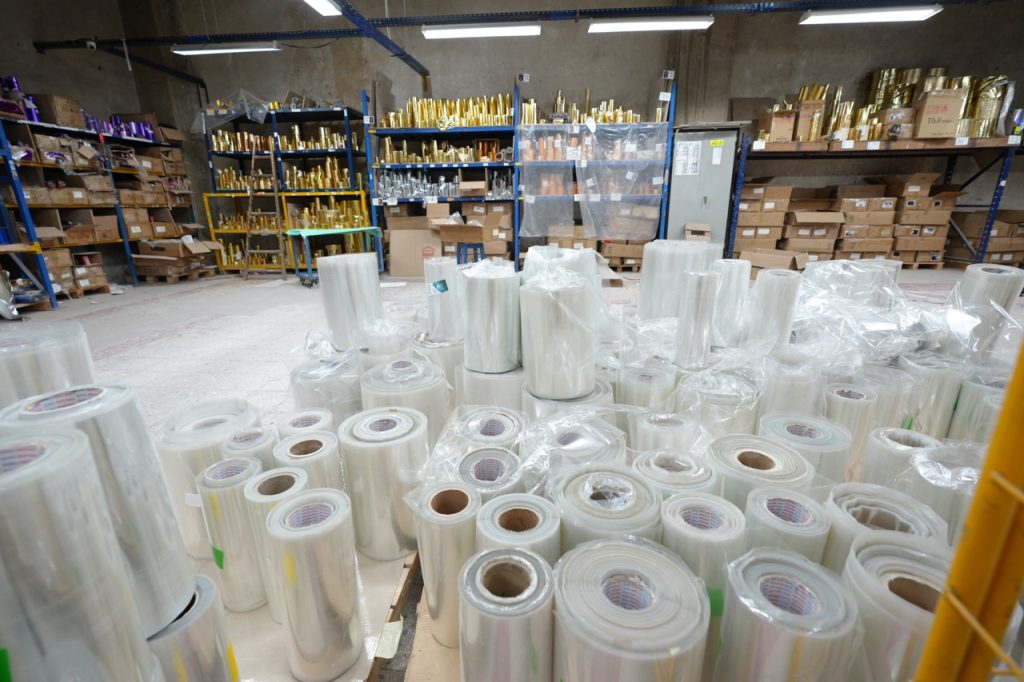
ETALEX has manufactured printed labels in Cairo since 1952, and self-adhesive labels are a large part of what we print. This explainer covers what a pressure-sensitive label is, what each layer does, how the adhesive actually sticks and the main adhesive types. When you are ready to choose materials for a particular container, our guide to self-adhesive label materials takes over.
What is a pressure-sensitive label?
A pressure-sensitive label is a printed label coated on the back with an adhesive that is permanently tacky at room temperature. The Pressure Sensitive Tape Council (PSTC) defines such adhesives as ones that adhere “upon mere contact without the need of more than finger or hand pressure” and that “require no activation by water, solvent, or heat”.
That is the difference from older label types. A wet-glue label is a plain printed sheet and the glue is applied on the labelling line; a pressure-sensitive label arrives with its adhesive already in place, protected by a liner. You peel it off, press it on, and it holds.
Are pressure-sensitive and self-adhesive labels the same thing?
Yes. “Pressure-sensitive label” and “self-adhesive label” describe the same product: the first name refers to how the adhesive is activated, the second to the label carrying its own adhesive. You will also see “PSA labels”, after pressure-sensitive adhesive, and, informally, “stickers”.
Material suppliers use the terms interchangeably: HERMA, a German producer of label materials, describes its “self-adhesive materials”, while Avery Dennison’s and UPM’s adhesive ranges are sold as “pressure-sensitive adhesives”.
The term covers paper and film labels, permanent and removable; what unites them is the construction. Our self-adhesive labels page shows the label types we produce for pharmaceutical, cosmetics, food, detergent, lubricant and industrial packs.
What layers make up a pressure-sensitive label?
A pressure-sensitive label starts life as a laminate of three components: facestock, adhesive and release liner. Avery Dennison’s white paper on liners states that “a standard self-adhesive labelling laminate consists of a liner, an adhesive and a facestock”. The label printer then adds the print and any protective coating on top.
HERMA describes the same thing as “pre-coated composites consisting of the components label material, adhesive and release liner”.
| Layer | What it is | What it does |
|---|---|---|
| Varnish or overlaminate (optional) | A clear coating or film applied over the print | Protects the print from rubbing, moisture and product splashes |
| Inks applied by the label printer | Carries the brand, text, codes and colour | |
| Facestock | Paper or film, sometimes top-coated to accept print | Forms the visible label and sets its look, strength and conformability |
| Adhesive | A pressure-sensitive adhesive coated on the back of the facestock | Bonds the label to the container on light pressure |
| Release coating | A thin silicone layer on the liner | Lets the label peel away cleanly without the adhesive sticking to the liner |
| Liner | Glassine paper or film (mostly PET), also called the backing | Protects the adhesive and carries the labels through printing, die-cutting and application |
Sources: Avery Dennison; HERMA; PSTC; FINAT and AFERA (see Sources).
FINAT, the European self-adhesive label association, and AFERA, the European adhesive tape association, describe it in a 2026 position paper as preserving “the integrity of the adhesive surface”, preventing “premature adhesion” and enabling the product “to be processed and applied as intended”. It is also a large share of the material: Avery Dennison’s white paper says release liner “can constitute up to 35% of the unprinted label laminate”, especially with thin facestocks. Avery Dennison names glassine and filmic, mostly PET, as the two widely used liner types.
How does a pressure-sensitive adhesive actually stick?
It sticks by close contact rather than by drying or setting. Avery Dennison explains that pressure-sensitive adhesives bond through van der Waals forces, weak attractions that work only over very short distances, so the adhesive must flow into close contact with the surface. Pressure brings it into contact; time lets it flow and build strength.
Avery Dennison’s adhesive guide uses a few terms worth knowing:
- Initial tack: “the immediate holding power of the label upon contact”, the grab you feel at application.
- Peel adhesion: the force needed to make the bond fail, which Avery Dennison measures with FINAT Test Method 2.
- Shear resistance: the internal strength of the adhesive; a low-shear adhesive is soft and tends to flow.
- Dwell time: the time an adhesive takes to build ultimate adhesion, which the guide puts at 2 to 24 hours depending on conditions. Avery Dennison’s article on van der Waals forces notes it can be “as much as 72 hours” in some applications.
The surface matters as much as the adhesive. The same guide says polar surfaces such as glass and PET have high surface energy and “are easier to stick to”, while apolar surfaces such as HDPE and PVC have low surface energy, so adhesives “don’t stick as easily”. Dust, oil and rough texture reduce contact.
What types of pressure-sensitive adhesive are there?
Adhesives are usually described in two ways: by chemistry and coating technology, and by how the label behaves once applied. Avery Dennison’s European guide says it offers “more than 160 specifically-tailored adhesive variants” in Europe alone, so each family below covers many grades.
By chemistry, as described in Avery Dennison’s adhesive guide:
- Emulsion acrylic: an acrylic polymer suspended in water; suited to high-speed converting and, per the guide, “an excellent choice for food contact”.
- Hot-melt rubber: strong adhesion and tack on a broad range of surfaces, with “the best low-temperature performance”, and good adhesion on rough or contaminated surfaces.
- Solvent acrylic: high adhesion on many substrates, with “exceptional water, heat, and chemical resistance”.
- Solvent rubber: ranging “from ultra-permanent to cleanly removable”, with high chemical and water resistance.
- UV-cured acrylic hot-melt: long-life adhesives for industrial, outdoor and chemical containers.
By behaviour, as material suppliers such as UPM and HERMA group their ranges:
- Permanent: stays on for the product’s life; Avery Dennison’s glossary says the label “cannot be removed without damaging either the label or the substrate”.
- Removable: holds during use, then peels off without damage or residue.
- Semi-permanent: between the two, listed as a separate option by HERMA.
- Wash-off: releases in a washing process, for returnable or recyclable containers, according to UPM.
- Reclosure or open-close: peels and re-seals repeatedly; Avery Dennison cites packs of wet wipes.
- Freezer or deep-freeze: formulated to grab when applied to cold packs, listed as a separate class in Avery Dennison’s overview.
How does temperature affect a pressure-sensitive adhesive?
Temperature affects both application and the life of the label. Avery Dennison’s guide separates minimum application temperature, the lowest recommended temperature during labelling, from service temperature, the range a label can withstand once applied. It says most of its adhesives are designed for a minimum application temperature of +5°C, while its regular adhesives survive -40°C to +80°C in service.
The guide also warns that “a removable adhesive at room temperature is actually permanent at low temperature”, because tack and flow change as the adhesive cools. For packs that are chilled, frozen or wet at labelling, see our guide to waterproof, freezer and chemical-resistant labels.
How are pressure-sensitive labels made and applied?
The label printer starts with reels of laminate (facestock, adhesive and liner together), prints the face, adds any varnish or finish, then die-cuts the label shapes through the facestock and adhesive without cutting the liner. The surrounding waste, called the matrix, is stripped away, leaving labels spaced on the liner, which is wound into rolls or cut into sheets.
At the filling line, an applicator peels each label from the liner and presses it onto the pack; small runs can be applied by hand.
ETALEX prints in-house with letterpress (flat and rotary), rotary offset, flexography, silk screen and digital printing, with hot stamping and embossing for finishing. See our label printing technologies and the guide to label printing methods for how each process suits different runs.
What should you decide before ordering pressure-sensitive labels?
Define the job before choosing materials: the container material, shape and surface; the product inside; temperature and moisture at labelling and in storage; how long the label must last; whether it must come off; and whether it is applied by hand or by machine.
Those answers drive the choice of facestock, adhesive and liner, which our material selection guide explains layer by layer. Our label quote checklist lists the details a printer needs to quote accurately.
Frequently asked questions
Is a pressure-sensitive label the same as a sticker? In construction, yes: both are a printed face material with a pressure-sensitive adhesive on a release liner. “Sticker” is the everyday word; “pressure-sensitive label” or “self-adhesive label” is the industry term for product and packaging labels.
Do pressure-sensitive labels need heat or water to stick? No. The adhesive is already tacky and bonds with light pressure. The PSTC definition states that pressure-sensitive adhesives “require no activation by water, solvent, or heat”. The bond does strengthen over time as the adhesive flows into the surface, which is why adhesion is best judged after dwell time.
What is the backing paper on a label called? It is the release liner, also called the backing: usually glassine paper or PET film coated with silicone so the adhesive releases cleanly. It protects the adhesive and carries the labels through printing and application, then is removed.
Can a pressure-sensitive label be removed cleanly? Only if it uses a removable or wash-off adhesive designed for that surface. Permanent adhesives are made to stay on, and Avery Dennison notes that a removable adhesive can behave permanently at low temperature. If clean removal matters, say so when you specify the label.
Sources
- ETALEX, About page. https://www.etalex.com/about/. Accessed 8 October 2026 (live page). Used for: established in Cairo in 1952; letterpress in flat and rotary, rotary offset, flexography, silk screen, digital printing and hot stamping; embossed and self-adhesive labels.
- Pressure Sensitive Tape Council (PSTC), “PSA Tape Glossary”. https://pstc.org/why-tape/psa-tape-glossary/. Accessed 8 October 2026. Used for: definition of pressure-sensitive adhesive (adheres “upon mere contact without the need of more than finger or hand pressure”; “require no activation by water, solvent, or heat”); definitions of release liner and face stock.
- Avery Dennison, “Adhesive Technologies: Labels + Packaging Technical Guide, Europe 2020” (PDF). https://label.averydennison.com/content/dam/averydennison/lpm-responsive/europe/english/documents/product-overviews/product/adhesives/lpm-eu-technical%20guide-adhesive%20technologies-2020-web.pdf. Accessed 8 October 2026. Used for: emulsion, hot-melt and solvent coating technologies; more than 160 adhesive variants in Europe; properties of emulsion acrylic, hot-melt rubber, solvent acrylic, solvent rubber and hot-melt UV-acrylic adhesives; high and low surface energy surfaces; minimum application temperature +5°C and service temperature -40°C to +80°C for regular adhesives; removable adhesive permanent at low temperature; glossary definitions of initial tack, peel adhesion (FTM 2), shear resistance, dwell time (2 to 24 hours), permanent and removable.
- Avery Dennison, “The role of van der Waals forces in pressure-sensitive adhesives”. https://electrified.averydennison.com/en/home/industries/electric-vehicles/design-production-application/the-role-of-van-der-waals-forces-in-psa.html. Accessed 8 October 2026. Used for: PSAs need no activation with heat, UV light or solvent; bonding through van der Waals forces requiring intimate contact; dwell time can be as much as 72 hours.
- Avery Dennison, “Pressure-Sensitive Adhesives” overview (last updated July 2017, PDF). https://label.averydennison.com/content/dam/averydennison/lpm-responsive/europe/english/documents/product-overviews/product/film/rigid-film/pressure-sensitive-adhesives-overview-brochure.pdf. Accessed 8 October 2026. Used for: four types of pressure-sensitive adhesive (emulsions, solutions, hot-melts, ultraviolet); classification into permanent, removable and reclosure, wash-off and deep-freeze grades; everyday examples such as postage stamps and mailing labels.
- Avery Dennison, “Label liners: meeting the sustainability challenge” (white paper, PDF). https://label.averydennison.com/content/dam/averydennison/lpm-responsive/europe/english/images/products/film/sustainability-clear-intenst/white-paper-on-liner-sustainability.pdf. Accessed 8 October 2026. Used for: standard self-adhesive laminate consists of liner, adhesive and facestock; release liner up to 35% of the unprinted label laminate; glassine and filmic (mostly PET) liners; silicone-coated liners; matrix waste as a by-product of label production.
- FINAT and AFERA, “Treatment of release liners under the PPWR” (position paper, July 2026, PDF). https://www.finat.com/documents/1412/finat-afera-position-paper-on-release-liner-2026.pdf. Accessed 8 October 2026. Used for: the release liner preserves the integrity of the adhesive surface, prevents premature adhesion and enables the product to be processed and applied as intended.
- HERMA, “Products” (self-adhesive materials). https://www.herma.com/material/products/. Accessed 8 October 2026. Used for: self-adhesive materials as pre-coated composites of label material, adhesive and release liner; acrylate dispersion and hot-melt adhesives; permanent, semi-permanent and removable adhesion; glassine, kraft and PET liners; top-coated and non top-coated PE and PP films.
- UPM Adhesive Materials (UPM Raflatac), “Adhesives”. https://www.adhesivematerials.upm.com/label-solutions/label-types/adhesives/. Accessed 8 October 2026. Used for: pressure-sensitive adhesive types from permanent and strong permanent to removable, wash-off and open-closure; descriptions of permanent, removable and wash-off adhesives.
Written by
Etalex Team
Content & Editorial Team
Practical guidance on label printing, finishing, materials and packaging, informed by Etalex's manufacturing experience in Cairo since 1952.
Related guides
Materials & Technology
What Is Flexographic Printing? Process, Strengths and Limits
Key answer Flexographic printing (flexo) is a relief printing process. A flexible plate with a raised image is inked by an engraved anilox roller, which…
Industry Insights
Industrial Labels: Durability Requirements and Material Options
Key answer An industrial label has to stay attached and readable for as long as the product is in use, often years, through abrasion, oils,…
Industry Insights
Motor Oil and Lubricant Labels: Oil Resistance and Adhesion on Plastic Containers
Key answer Motor oil labels fail mainly at the edges: plastic oil containers are hard surfaces for adhesives to grip, and oil on the pack…
Talk to the Etalex team
Ready to discuss your labels?
Send the size, quantity, material, finish and container, with artwork if you have it. Our team in Cairo replies during working hours, Sunday to Thursday.