What Is Embossing on Labels? Blind, Registered and Combined Finishes
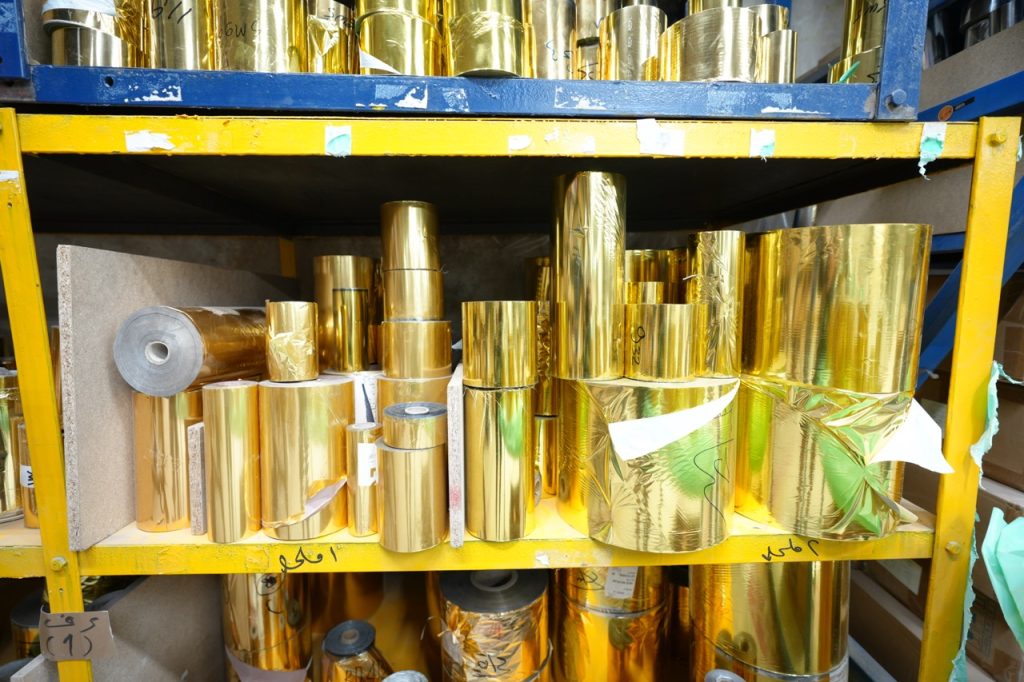
ETALEX has manufactured printed labels in Cairo since 1952. Embossed labels are part of our premium finishing range, alongside hot stamping, which we do in-house. This guide explains what embossing is, the main types used in the label industry, which stocks take it well and what to tell a supplier.
What is embossing on a label?
Embossing is a finishing process that raises selected areas of a label so they can be felt as well as seen. Avery Dennison’s technical guide to label embossing describes it as lifting the design from the surface, “usually by means of coupling male and female dies”. Light and shadow on the relief then make the design stand out.
The two halves of the tool work together. The female die carries the image as “a low relief”, and the male part presses the paper into it. Die maker Tomlinson calls this matching part a counterforce, a mirror image of the die. Reverse the order and you get debossing: the design is pressed into the label instead of raised above it.
What is the difference between blind, registered and combined embossing?
The three names describe what the relief sits on. Blind embossing raises an unprinted area, so the design shows only as relief. Registered embossing aligns the relief with printed or foiled elements. Combined embossing, often called combination stamping, pairs embossing with foil stamping in one design, so the raised area also shines.
- Blind embossing. Hinderer + Mühlich (H+M), a German maker of stamping and embossing dies, says it is “created exclusively using a stamping die, with no other finishing materials”. It suits subtle logos, crests and textures.
- Registered embossing. Tomlinson explains that embossed areas can “register with printed or foiled elements of a design making them physically stand out”. The relief must land exactly on the artwork, so register tolerance matters.
- Combined (foil and emboss). H+M describes “combined stamping dies (blind embossing and foil stamping), as they can be found in a typical label production”. Some converters foil and emboss with one combined die; others use separate steps registered to each other.
Industry suppliers also distinguish the shape of the relief. Tomlinson describes a single-level die as raising the image “to a fixed height throughout”, and a multi-level die as raising it “to multiple heights adding a three-dimensional, sculptured look”. H+M lists round, prismatic, flat, single-level, multi-level and sculptured reliefs, each available embossed or debossed. Ask which of these a converter offers before designing around one.
| Finish | What you see and feel | Typical use | Points to check |
|---|---|---|---|
| Blind embossing | Raised relief with no ink or foil; shows by light and shadow | Discreet logos, crests, borders, textures | Contrast is subtle on very light or busy backgrounds |
| Registered embossing | Relief aligned with a printed element | Making a printed logo or name stand out physically | Register tolerance between print and relief; leave margin in the artwork |
| Combined foil and emboss | Raised relief that also carries metallic or coloured foil | Brand names and logos on premium packs | Foil, die and stock must be matched; one die or separate steps |
| Debossing | Design pressed into the surface | Understated marks, textured paper effects | Depth depends on the stock |
| Single-level relief | Flat-topped relief at one height | Lettering, simple logos | Fine detail may close up in thin or hard stocks |
| Multi-level or sculpted relief | Several heights, rounded or faceted shapes | Crests, portraits, detailed emblems | Generally needs more complex tooling; confirm the converter offers it |
Sources: Avery Dennison M_use; Hinderer + Mühlich; Tomlinson (see Sources).
Is embossing the same as hot stamping?
No. Hot stamping transfers foil to the label with a heated die and pressure; embossing changes the shape of the label itself. KURZ, a foil manufacturer, states that “blind embossing is not a hot stamping process”, because no foil is transferred: it adds no gloss or colour, only relief. The two are often combined.
Many premium labels use both: foil gives shine, embossing gives touch. H+M notes that embossing in combination with foil stamping creates “impressive visual & tactile effects”. Cold foil, another way to add metallic effects, is applied on the printing press and adds no relief of its own; our comparison of hot stamping and cold foil explains the difference and when each is used.
Which label stocks emboss well?
Paper is the natural choice, and thicker, softer stocks usually give deeper relief. H+M explains that “the design of the motif, paper choice, and grammage influence how deep the embossing can be”, and that “the more voluminous the substrate is, the deeper the embossing can be applied”. Films can be embossed too, but test the result first.
Label stock makers present paper as the material for embellishment. Avery Dennison’s guide to paper label materials says that “from hot-foil stamping to embossing and more, paper can take it all”, and lists embossing and debossing among the embellishments to consider when choosing a material. Fedrigoni’s self-adhesive range includes felt-marked, laid, soft-touch and embossed papers.
Do not confuse a pre-textured paper with an embossed design. Avery Dennison’s Fasson Design Papers include, for example, a felt-marked paper and one with a “hammered” tactile embossed finish over the whole sheet, aimed at wine, spirits and specialist foods. That texture comes with the paper; embossing a logo is a separate step with its own tooling. The two can be combined. For the wider choice of facestock and adhesive, see our guide to self-adhesive label materials.
How should you design artwork for an embossed self-adhesive label?
Keep the relief away from the label’s edges and give it room. Avery Dennison warns that embossing a pressure-sensitive label creates a pocket of air between the adhesive and the container, and advises “at least 5mm without relief at the label’s edge” so the edges hold, especially in humid conditions.
A few more points help in practice:
- Separate layer. Supply the area to be embossed as its own vector layer, apart from print and any foil layer, so the die can be made from it.
- Space between reliefs. Avery Dennison recommends maximising the space between raised areas.
- Detail and depth. Very fine lines and small text may not hold in relief; ask the converter what minimum size suits the chosen stock.
- Container shape. On small or tightly curved containers, relief adds stiffness and air pockets at the curve. Our guide to labels for small bottles covers diameter and application.
- Register. For registered or combined work, allow tolerance between the printed edge and the relief rather than drawing them hard against each other.
Where is label embossing used?
Embossing is used wherever touch helps sell a product: cosmetics and perfume, wine and spirits, specialist foods and gift packaging. A raised logo signals quality and is felt the moment a customer picks the pack up. It is most common on paper labels in premium categories, often combined with foil or a matte finish.
In cosmetics, embossing usually sits with hot foil, varnish or lamination on the same label. Our guide to cosmetic and perfume labels compares these finishes by look, feel and durability, and our cosmetics labels page shows how we approach the category.
What should you tell your label manufacturer?
Tell the supplier what you want raised, how it should look and feel, and what the label goes on. With the artwork layer, the finish type, the stock and the container, a manufacturer can choose the tooling and process, check feasibility and price the job. Include:
- The element to be embossed (logo, name, border or pattern) as a separate vector layer.
- Blind, registered or combined with foil, and the foil colour if any.
- Raised or debossed, and the effect you want: crisp and flat, or rounded and sculpted.
- The preferred stock, or the look you want if you have not chosen one.
- The container, its shape and diameter, and how labels are applied.
- Storage and use conditions, such as humidity, chilling or handling.
- Label size, quantity, number of versions and whether repeat orders are expected.
ETALEX prints in-house with letterpress (flat and rotary), rotary offset, flexography, silk screen and digital printing, with hot stamping and embossing for finishing; see our printing technologies. Our label quote checklist covers the full specification, and our embossed labels page shows the finish in our range.
Frequently asked questions
What is the difference between embossing and debossing? Embossing raises the design above the label surface; debossing presses it into the surface. Both use a die and a matching counter, with the order reversed, and both can be blind or combined with print or foil.
Can foil and embossing be combined on one label? Yes. Foil and relief can be applied to the same design, either with a combined die that foils and embosses together or in separate registered steps. Which route is used depends on the converter’s equipment, so ask how it will be produced before approving artwork.
Does embossing work on film labels? It can, but paper is the more common choice, and thicker, softer stocks generally give deeper relief. If your design needs a film for water or oil resistance, ask for the embossing to be trialled on that film before approving the run.
Will embossing make a label lift at the edges? It can if the relief runs too close to the edge, because embossing traps small pockets of air under the label. Avery Dennison advises leaving at least 5 mm without relief at the edge, which matters most in humid conditions and on curved containers.
Sources
- ETALEX, Embossed Labels page. https://www.etalex.com/services/embossed-labels/. Accessed 8 October 2026 (live page). Used for: embossing raises selected areas such as a logo, name or border; embossed labels as part of the premium finishing range; hot stamping described as transferring foil with a heated die; Cairo, founded 1952.
- ETALEX, About page. https://www.etalex.com/about/. Accessed 8 October 2026 (live page). Used for: founded 1952 in Cairo; letterpress in flat and rotary, rotary offset, flexography, silk screen, digital printing and hot stamping; embossed labels.
- Avery Dennison M_use, “Technical Guide to Label Embossing”. https://www.my-muse.com/en/home/insights/label-embossing.html. Accessed 8 October 2026. Used for: definition of embossing by male and female dies; female die as low relief; debossing as the reverse order; blind embossing in non-printed areas; registered embossing; air pocket under relief on pressure-sensitive labels; at least 5 mm without relief at the edge; maximise space between reliefs; example combining embossing with hot foil.
- Hinderer + Mühlich, “Embossing” (blind embossing). https://hinderer-muehlich.com/en/graphics/product-portfolio/stamping-dies/embossing.html. Accessed 8 October 2026. Used for: blind embossing created exclusively with a stamping die and no other finishing materials; light and shadow; round, prismatic, flat, single-level, multi-level and sculptured reliefs, embossed or debossed; motif, paper choice and grammage influence depth; more voluminous substrate allows deeper embossing; blind embossing combinable with most other stamping techniques.
- Hinderer + Mühlich, “Outstanding embellishment for packaging and labels”. https://hinderer-muehlich.com/en/graphics/applications.html. Accessed 8 October 2026. Used for: combined stamping dies (blind embossing and foil stamping) as found in typical label production.
- Hinderer + Mühlich, “Hot foil stamping dies & embossing dies. CNC engraved.” https://hinderer-muehlich.com/en/stamping-tools-top-quality-products-for-the-graphics-industry/stamping-dies-counter-dies-set-up-systems-make-ready-material/hot-foil-stamping-dies-embossing-dies-cnc-engraved. Accessed 8 October 2026. Used for: in combination with foil stamping, impressive visual and tactile effects; combination stamping adds relief.
- Tomlinson, “Emboss”. https://tomlinsonlimited.co.uk/what-we-do/emboss. Accessed 8 October 2026. Used for: single-level die raises the image to a fixed height; multi-level die raises it to multiple heights with a sculptured look; embossing registered with printed or foiled elements, or blind; resin counterforce as a mirror image of the die.
- KURZ Graphics, “What is hot stamping? FAQ”. https://www.kurz-graphics.com/en/hot-stamping/faq-hot-stamping/. Accessed 8 October 2026. Used for: hot stamping transfers foil layers with a heated die and mechanical pressure; blind embossing is not a hot stamping process because no foil is transferred, so it adds no gloss or colour.
- Avery Dennison, “Paper Materials: Labels + Packaging Technical Guide, Europe 2021” (PDF). https://label.averydennison.com/content/dam/averydennison/lpm-responsive/europe/english/documents/customer-tools/lpm-eu-technical%20guide-paper%20materials-2021-web.pdf. Accessed 8 October 2026. Used for: “from hot-foil stamping to embossing and more, paper can take it all”; embossing and debossing listed among embellishments to consider when choosing a material; paper textures.
- Avery Dennison, “Fasson Design Paper Range” (product data sheet, PDF). https://graphics.averydennison.com/content/dam/averydennison/graphics/eu/en/Data-Sheets/Design-Papers/ds_Fasson_Design_Papers_EN_2019.pdf. Accessed 8 October 2026. Used for: felt-marked paper (Rustique Blanc) and a paper with a “hammered” tactile embossed finish (Martele Blanc); recommended for wine, spirits and specialist foods.
- Fedrigoni Self-Adhesives, “Label adhesive papers”. https://selfadhesives.fedrigoni.com/product/labels/papers/. Accessed 8 October 2026. Used for: self-adhesive special papers including felt-marked, pearlescent, soft-touch, laid and embossed papers.
Written by
Etalex Team
Content & Editorial Team
Practical guidance on label printing, finishing, materials and packaging, informed by Etalex's manufacturing experience in Cairo since 1952.
Related guides
Guides
Labels for Small Bottles and Cylinders: Design and Application Tips
Key answer On small bottles and tight cylinders, labels tend to lift at the edges because the material wants to spring back flat. Choose a…
Industry Insights
Cosmetic and Perfume Labels: Finishes, Materials and Durability
Key answer A cosmetic or perfume label has to look premium and stay that way through handling, water and skin oils. Choose the look first…
Guides
Hot Stamping vs Cold Foil on Labels: Differences, Cost Drivers and When to Use Each
Key answer Hot foil stamping transfers foil to a label with a heated metal die and pressure, in its own station or pass. Cold foil…
Talk to the Etalex team
Ready to discuss your labels?
Send the size, quantity, material, finish and container, with artwork if you have it. Our team in Cairo replies during working hours, Sunday to Thursday.