What Is Flexographic Printing? Process, Strengths and Limits
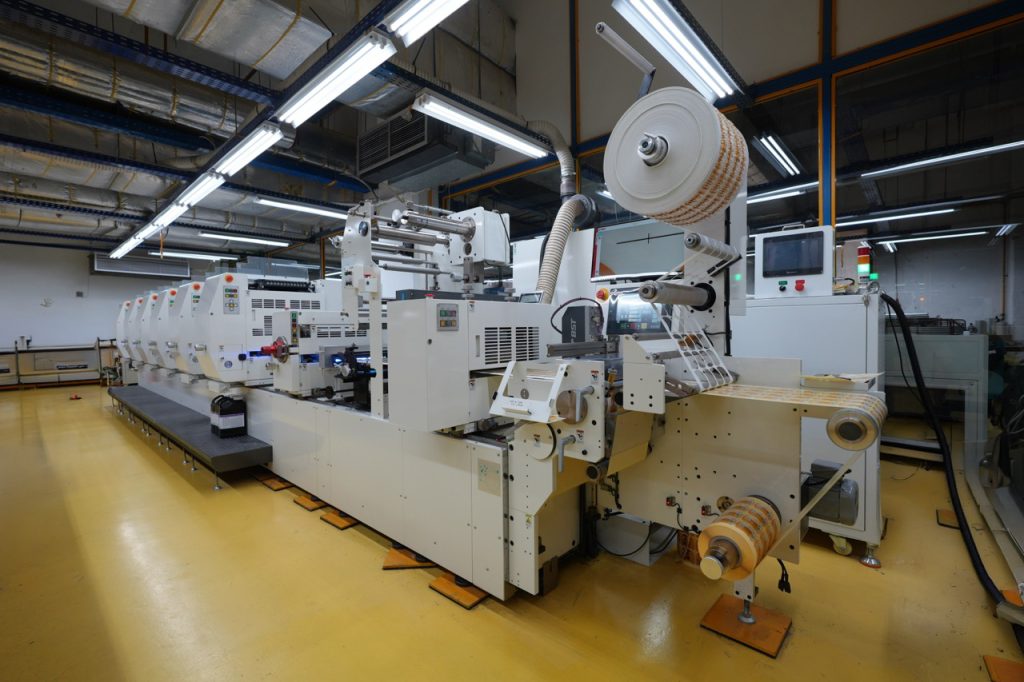
ETALEX has manufactured printed labels in Cairo since 1952, and flexography is one of the processes we run in-house alongside letterpress (flat and rotary), rotary offset, silk screen and digital printing, with hot stamping and embossing for finishing. This guide explains how flexo works, its strengths and limits, and what to ask before approving a flexo label job.
What is flexographic printing?
Flexographic printing is a plate-based relief process: the image stands up from a flexible plate, only the raised areas take ink, and they transfer that ink to the substrate. Our printing technologies page sums it up: flexo “prints from flexible relief plates with fluid inks and works on a wide range of papers and films”.
Three features define it:
- Flexible relief plates. Usually photopolymer, imaged from your artwork and mounted on a cylinder or sleeve. Esko, a pre-press software maker, lists labels, flexible packaging, folding cartons and corrugated among flexo applications.
- Metered fluid ink. Water-based, solvent-based or UV-curable inks are delivered to the plate by an anilox roller.
- Roll-to-roll printing. The material runs as a continuous web, so printing can be followed by varnishing, die-cutting and other finishing.
How does the flexographic printing process work?
A flexo job moves from artwork to plates, then through one print station per colour on the press. At each station an anilox roller carries a measured film of ink to the plate, the plate prints onto the web against an impression cylinder, and the ink is dried or cured before the next colour. The sequence below is typical.
- Pre-press and plates. Artwork is separated into colours and screened, and one plate is made for each colour. Plates are mounted on cylinders or sleeves in register with each other.
- Inking. Ink is fed to the anilox roller and a doctor blade wipes the surface, leaving ink only in the engraved cells. Mark Andy, a label press manufacturer, describes an anilox as a roller with “many millions of tiny cups engraved into its surface that hold ink”, and notes that only “25% – 50% of the ink is actually transferred from the cell”.
- Printing. The anilox touches the raised areas of the plate, and the plate touches the label web, which is supported by the impression cylinder. Pressure is kept light: Miraclon, a flexo plate maker, calls over-impression “one of the leading causes of plate damage”.
- Drying or curing. Water-based and solvent-based inks dry by evaporation; UV inks cure under ultraviolet light.
- Converting. On a label press the printed web can be varnished or laminated, die-cut and rewound as finished rolls. See how labels are made for the full journey.
What can flexo print on, and with which inks?
Flexo prints on a wide range of papers and films, and the same process is used for folding cartons and corrugated board. The ink system is chosen with the substrate: water-based, solvent-based and UV-curable inks dry differently and adhere differently, and films may need surface treatment so the ink wets out and bonds.
The Flexographic Technical Association (FTA) notes that “most narrow web and many mid web flexo printers are now using water-based or UV energy-curable inks” for films. It warns that with water-based inks, wetting and adhesion on some substrates can be challenging, and that they “typically need 24 hours to cure for full adhesion and for full durability properties”.
Film is the harder case. In an FTA article, Scot Pedersen of Siegwerk, an ink maker, explains that solvent-borne inks generally have surface energies of 36 to 38 dynes/cm; “if the film has surface energy below this level, the inks will not lay smoothly”. Corona treatment raises the film’s surface energy. So ink, facestock and any varnish should be agreed together. Our guide to self-adhesive label materials covers the facestock side.
What are the strengths of flexographic printing?
Flexo’s main strength is efficiency once a job is set up: the same plates and ink can run as long as needed, so cost per label falls as quantities rise. It also prints on a wide range of papers and films, gives strong solids and spot colours, and suits inline converting.
- Economy on longer runs. Mark Andy writes that “long-runs and minimal SKUs are most profitable on flexo presses due to the press’ ability to run as long as needed with the same ink and plates”, and describes jobs of “5,000 ft+” of web as “best suited for flexo production”.
- Substrate range. Mark Andy lists prime labels, in-mould labels and shrink sleeves among the applications of its flexo presses.
- Improving image quality. Esko states that finer imaging lets “smaller minimum dots” be held on the plate and printed reproducibly, with smoother highlights and vignettes.
| Aspect | What it means for a label buyer | Question to ask the printer |
|---|---|---|
| Set-up | One plate per colour; platemaking and mounting take time and cost money before the first good label | Which plate and set-up costs apply, and are they one-off for repeat orders? |
| Run length | Cost per label falls as quantities rise; very short runs carry the set-up cost over few labels | At what quantity does flexo become better value than digital for this job? |
| Versions | Each artwork change needs new plates for the colours that change | Can common colours stay on shared plates across versions? |
| Colour | Strong solids and spot colours; consistency depends on anilox, ink and press control | How is colour checked from run to run, and against what standard? |
| Fine detail | Very small highlight dots and fine type are harder to hold than in offset | Will the smallest text and tints in our artwork print cleanly? |
| Substrates | Wide range of papers and films; films may need treatment and suitable inks | Which ink system will you use on our material, and has it been run before? |
Sources: Mark Andy; Esko; Miraclon; FTA (see Sources).
What are the limits of flexographic printing?
Flexo’s limits come mainly from its plates and its fluid inks. Every new design or version needs new plates, which adds cost and time to short runs, and very fine tints and small text are harder to hold than in offset. Colour can drift if the anilox wears or plugs, so process control matters.
- Set-up time and cost. Mark Andy calls “platemaking, plate mounting, and changeovers” important “yet time-consuming processes” that can delay delivery, and notes that digital avoids “the costs of creating and setting up unique plates for each element”.
- Highlights and fine detail. Small dots can be over-inked when they dip into the anilox cells; Esko advises that the largest dots in a screen should always be larger than the anilox cells.
- Colour consistency. In an FTA article, Mike Poppen writes: “If the volume changes, the color changes and consistency is lost”, and a drop in colour strength is often the first sign of a plugged or worn anilox.
- Ink film and opacity. Silk screen can lay a thick, opaque or tactile ink film that other processes, flexo included, cannot, so such effects are often added by screen, and metallic effects by hot stamping.
- Complexity. Miraclon calls flexo “highly technical”, so the printer’s experience counts.
When is flexo the right choice for your labels?
Flexo is usually a strong choice when you order the same design in medium or large quantities, repeat it over time, and want strong spot colours on paper or film roll labels. Digital usually wins for very short runs, many versions or variable data. Many labels combine flexo with other processes.
Mark Andy puts it simply: for established products whose designs change rarely, “flexo is the way to go for peak efficiency”. If you are deciding between processes, our comparison of label printing methods sets flexo against rotary offset, letterpress, silk screen and digital on run length, detail and finish. For what drives the price of a run, see our guide to label printing cost.
Because ETALEX runs several processes in-house, the question for us is which process, or combination, fits your label.
What should you ask a printer about a flexo job?
Ask how many plates the job needs and what they cost, whether plates are kept for repeat orders, which ink system suits your material, whether your finest text and tints will hold, and how colour is approved and kept consistent between runs. Then ask which finishing runs in the same pass.
Our label quote checklist lists everything to send with a request, and our self-adhesive labels page covers the labels we make.
Frequently asked questions
What does flexographic printing mean? It is a printing process that uses flexible plates with a raised image. An anilox roller inks the raised areas with fluid ink, and the plate prints the image onto paper, film or board as a continuous web.
What is flexo printing mainly used for? Roll labels and packaging, such as flexible packaging, folding cartons and corrugated board, because it runs fast on a continuous web and prints on a wide range of papers and films.
Is flexo better than digital printing for labels? Neither is better in general. Flexo usually costs less per label on longer runs of the same design; digital needs no plates, so it suits short runs, many versions and variable data.
Why do flexo colours vary between runs? Ink delivery depends on the anilox roller, ink viscosity, drying and press pressure. A worn or plugged anilox carries less ink, so colour strength drops. Agree a colour standard and approval method with your printer.
Sources
- ETALEX, Printing Technologies page. https://www.etalex.com/services/printing-technologies/. Accessed 8 October 2026 (live page). Used for: flexography “prints from flexible relief plates with fluid inks and works on a wide range of papers and films”; widely used for roll labels and packaging; silk screen lays a thick, opaque or tactile ink film other processes cannot; offset known for fine detail.
- ETALEX, About page. https://www.etalex.com/about/. Accessed 8 October 2026 (live page). Used for: founded 1952 in Cairo; letterpress, rotary offset, flexography, silk screen, digital printing and hot stamping, with embossing.
- Mark Andy, “RX for Success: Dr. Flexo on The Importance of Maintaining Clean Anilox Rolls”, 30 August 2018. https://www.markandy.com/news/rx-for-success-dr-flexo-on-the-importance-of-maintaining-clean-anilox-rolls/. Accessed 8 October 2026. Used for: definition of an anilox (“many millions of tiny cups”); ink path from anilox to plate to substrate; only 25% to 50% of ink transfers from each cell; cell plugging changes colour.
- Mark Andy, “4 Myths About Flexo (And Why They’re Wrong)”, 6 February 2019. https://www.markandy.com/news/4-myths-about-flexo-and-why-theyre-wrong/. Accessed 8 October 2026. Used for: long runs and minimal SKUs most profitable on flexo with the same ink and plates; jobs of 5,000 ft+ best suited for flexo.
- Mark Andy, “Flexo or Digital Hybrid: Which Production Method is Right for You?”, 12 February 2018. https://www.markandy.com/news/flexo-digital-hybrid-production/. Accessed 8 October 2026. Used for: flexo designed for long runs; platemaking, mounting and changeovers time-consuming; digital avoids plate costs for each element; flexo “the way to go for peak efficiency” on established designs.
- Mark Andy, “Performance Series Flexo Presses”. https://www.markandy.com/equipment/flexo-presses/performance-series/. Accessed 8 October 2026. Used for: flexo label applications including prime labels, in-mould labels and shrink sleeves on film, supported and unsupported materials; inline converting.
- Esko, “HD Flexo Application Guide” (ColorPilot 23.07, PDF). https://docs.esko.com/docs/en-us/colorpilot/23.07/referenceguide/pdf/Flexo_Application_Guide.pdf. Accessed 8 October 2026. Used for: applications include label printing, flexible packaging, folding cartons and corrugated; finer imaging holds smaller minimum dots reproducibly; highlight dots over-inked by dipping into anilox cells, so largest screen dots should exceed anilox cell size.
- Miraclon, “How to Troubleshoot Print Issues”. https://www.miraclon.com/flexo-know-how/how-to-troubleshoot-print-issues/. Accessed 8 October 2026. Used for: over-impression one of the leading causes of plate damage; fast-drying ink causing highlight dot loss and dirty print; ink viscosity and anilox selection affecting transfer and density.
- Miraclon, “Why simplifying matters in flexographic printing”. https://www.miraclon.com/stories/why-simplifying-matters-in-flexographic-printing/. Accessed 8 October 2026. Used for: plate, substrates, inks and anilox rollers interact; flexo “highly technical” and lack of standardisation “can drive complexity”.
- Flexographic Technical Association, “Important Considerations for Water-Based & UV Energy-Curable Inks”. https://www.flexography.org/industry-news/water-based-ink-uv-energy-curable-ink-considerations/. Accessed 8 October 2026. Used for: narrow and mid web printers mostly using water-based or UV inks on films; water-based inks low VOC, adhesion challenges on some substrates, 24 hours to cure for full adhesion and durability.
- Flexographic Technical Association (Scot Pedersen, Siegwerk), “Ink Meets Film: The Intricate Relationship”, 2018. https://www.flexography.org/industry-news/ink-film-relationship/. Accessed 8 October 2026. Used for: little mechanical adhesion on smooth films; solvent-borne inks 36 to 38 dynes/cm and poor lay-down on lower-energy films; corona treatment raises surface energy.
- Flexographic Technical Association (Mike Poppen), “The Secret to Print Consistency: Maintaining Anilox Roll Volume”. https://www.flexography.org/industry-news/print-consistency-maintain-anilox-roll-volume/. Accessed 8 October 2026. Used for: ink film thickness determines colour strength; “if the volume changes, the color changes”; plugging and wear reduce volume.
Written by
Etalex Team
Content & Editorial Team
Practical guidance on label printing, finishing, materials and packaging, informed by Etalex's manufacturing experience in Cairo since 1952.
Related guides
Guides
Troubleshooting Label Adhesion: Lifting, Curling and Wrinkling
Key answer Most label adhesion problems come from a mismatch between the label construction and real conditions at your line: container material and shape, surface…
Guides
Label Printing Cost: What Drives the Price
Key answer Label printing cost is set by your specification, not by a list price. Quantity and run length, the number of designs, size and…
Guides
Storing Labels: Temperature, Humidity and Shelf Life
Key answer Good label storage means keeping rolls sealed in their original packaging, in a clean, dry, dark place at moderate room temperature and humidity,…
Talk to the Etalex team
Ready to discuss your labels?
Send the size, quantity, material, finish and container, with artwork if you have it. Our team in Cairo replies during working hours, Sunday to Thursday.