Troubleshooting Label Adhesion: Lifting, Curling and Wrinkling
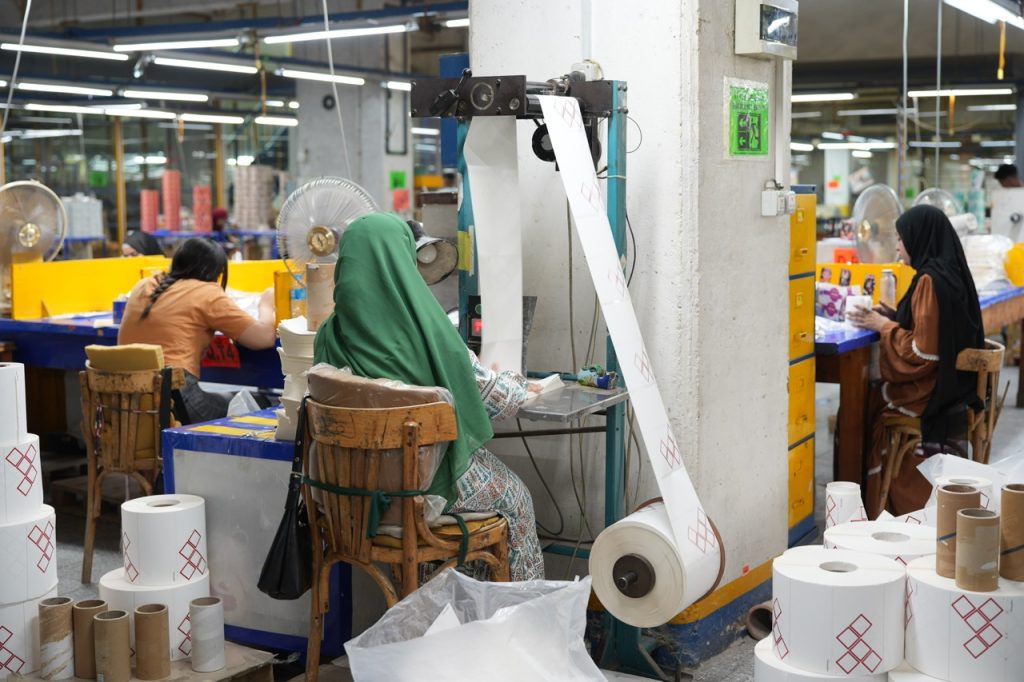
ETALEX has manufactured printed labels in Cairo since 1952. This guide helps production and quality teams narrow down why labels lift, fall off, curl or wrinkle, using published guidance from adhesive and label material manufacturers, and ends with what to tell whoever prints your self-adhesive labels.
What do lifting, curling and wrinkling actually mean?
They are different failures with different causes, so name the symptom precisely before changing anything. Edge lifting starts at a corner or edge; fall-off means the whole label lets go; curling is the label bending away from the liner or the pack; wrinkling and bubbles are creases or trapped air under the face.
- Edge lifting, or “flagging”: one or more edges rise from the surface, usually on a curve. UPM Raflatac defines edge lift as the outer edges of a label lifting from the surface it was applied to.
- Fall-off: the label never gripped, or let go later.
- Curl: on the roll or liner, or after application.
- Wrinkles and bubbles: often after squeezing or on shaped containers.
Note when each symptom appears: at the applicator, hours later or after storage. Timing is often the strongest clue.
Why do label edges lift on curved containers?
A curved pack asks the label to bend, and a stiff label tries to straighten. If the adhesive cannot hold against that spring-back, the edge rises. Avery Dennison calls the ability to resist this on a curved or tight-radius surface “mandrel hold”, the resistance to “flag” or “wing up”. Tighter curves need more conformable labels or stronger hold.
UPM Raflatac, writing about small injectable containers, says “the tighter the diameter curve then the higher the risk of label edge lifting”, describing containers of 7 to 23 mm diameter with the highest risk at 7 to 12 mm. It suggests an adhesive pre-tested for tight mandrel performance, thin papers or very conformable films, or a label that overlaps onto itself.
Avery Dennison’s film facestock whitepaper says stiffness “is determined by the thickness and modulus (rigidity) of the label”. Its troubleshooting guide adds inconsistent pressure, low application temperature, heavy ink or varnish on the edges, and a low surface energy or incompatible substrate. For very small packs, see our guide to labels for small bottles.
Why are labels not sticking, or falling off later?
Usually because the adhesive never made full contact with a clean, dry, compatible surface, or was never given time to build. Container material matters, and so do dust, oil, moisture, cold and contents migrating through the container wall. Check the surface and the temperature before you blame the adhesive itself.
The surface. Avery Dennison’s adhesive guide explains that polar surfaces such as PET and glass have high surface energy and are easier to stick to, while apolar surfaces such as PVC and HDPE have low surface energy, so adhesives “don’t stick as easily”. Its troubleshooting guide lists moisture or contamination on the substrate, contents migrating through containers, a rough surface or too little adhesive coat weight, and an adhesive not compatible with the substrate as causes of fall-off. Avery’s help centre adds that fingertip oils can dull the adhesive.
Temperature. The adhesive guide says most of its adhesives are designed for ambient conditions with a minimum application temperature of +5°C, and that tack falls as application temperature drops. Our guides to beverage bottle labels and waterproof, freezer and chemical-resistant labels cover chilled and wet packs.
Time. The same guide puts dwell time, the time an adhesive takes to build ultimate adhesion, at 2 to 24 hours depending on conditions.
What causes labels to wrinkle or trap air?
Wrinkles usually mean the label cannot follow the container’s shape or movement: a rigid film on a squeezable bottle, or a flat label on a waisted or tapered pack. Bubbles usually mean air was trapped during application, through uneven pressure, a rough or contaminated surface, or a container that was hot or cold when labelled.
Avery Dennison’s film facestock whitepaper states that any container that is squeezable, has a “waist” or is egg-shaped “requires conformable films”, and that conformable films perform better than rigid films on ridges, bumps and shaped edges. It names PE as the most conformable film, and says rigid films suit containers that are not squeezed and have a flat labelled area.
For air bubbles after labelling, Avery Dennison’s troubleshooting guide lists inconsistent pressure, an uneven container surface, contamination or moisture, hot filling and low application temperature. Its remedies include a squeegee, a clean substrate and, for hot filling, a special adhesive. Our guide to self-adhesive label materials explains how facestock, adhesive and liner work together.
Why do labels curl on the roll or after application?
Curl on the roll or liner usually points to moisture and storage: paper absorbs and releases moisture and changes shape. Curl after application usually points to a stiff facestock on a curve, heavy ink at the edges, or a label bent backwards as it was peeled from the liner. Each points to a different fix.
Avery Dennison’s storage bulletin says moisture causes paper stocks to swell, and recommends storing finished labels at 22°C and 50% relative humidity, in their boxes, never directly on concrete. It calls use within six months of receipt “usually a good manufacturing process”. Our guide to storing labels covers this further.
For hand application, Avery Dennison’s troubleshooting guide advises pulling the liner away from the label, not peeling the face, to avoid face curl.
Which symptom points to which cause?
Start from what you see, list the likely causes and run the simplest checks first. The table summarises the manufacturer guidance cited above. It is a starting point for discussion with your supplier, not a diagnosis: several causes can act together, so check the label construction against its data sheet too.
| Symptom | Likely causes | Checks to run |
|---|---|---|
| Edges lift on a round or small container | Facestock too stiff for the curve; adhesive with weak mandrel hold; too little pressure | Measure the diameter; press edges firmly; recheck after dwell time |
| Edges lift hours or days later | Low surface energy plastic; heavy ink or varnish at the edges; cold application | Confirm container material; check edge ink; record pack temperature |
| Label never grips or falls off | Dust, oil or moisture on the surface; pack too cold; incompatible adhesive | Wipe and dry a test pack; label at room temperature; compare results |
| Falls off after filling or storage | Contents migrating through the container; storage temperature outside the adhesive’s range | Check labelled packs empty versus filled; check service temperature on the data sheet |
| Wrinkles after squeezing | Rigid film on a squeezable pack | Ask whether the facestock is a conformable film |
| Wrinkles on shaped packs | Label area not flat; label too large for the flat zone | Check the label sits on the flattest part of the pack |
| Bubbles under the face | Uneven pressure; rough or wet surface; hot-filled or cold pack | Check applicator pressure; clean the surface; label at ambient temperature |
| Labels curl on the roll | Humidity and storage conditions | Check storage temperature, humidity and packaging |
Sources: Avery Dennison troubleshooting guide, adhesive guide, film facestock whitepaper and storage bulletin; UPM Raflatac (see Sources).
How do you check that a fix has worked?
Change one variable at a time, label real packs on your own line, and recheck them after the adhesive’s dwell time and again after storage. Record the container batch, the label batch, the pack temperature and the applicator settings, so that results can be compared and repeated rather than remembered.
FINAT, the European self-adhesive label association, publishes comparable test methods, including peel adhesion (FTM 1 and 2), loop tack (FTM 9), low temperature adhesion (FTM 13) and mandrel hold (FTM 24). Ask which method lies behind any quoted figure.
For round packs, Avery’s help centre suggests an overlapping wrap, pressed firmly for 5 to 10 seconds.
What should you tell your label supplier?
Give your supplier the symptom and the conditions, not just “the labels don’t stick”. A precise description lets a printer compare your container, line and storage with the data sheets of the materials it proposes, and helps everyone avoid repeating the same failure on the next run. Include:
- The symptom, and when it appears: at the line, after hours, or after storage.
- Container material, finish, shape, diameter and whether it is squeezed.
- Pack temperature and condition at labelling: dry, damp, chilled or hot-filled.
- Storage, transport and use conditions.
- Labelling method: by hand or machine, and the applicator used.
- How labels are stored before use.
- Photos of failed labels and the batches affected.
ETALEX prints in-house using letterpress (flat and rotary), rotary offset, flexography, silk screen and digital printing, with hot stamping and embossing for finishing; see our printing technologies. Our label quote checklist covers the full specification.
Frequently asked questions
Why are my labels not sticking to plastic bottles? Plastics such as HDPE have low surface energy, which Avery Dennison describes as harder to stick to than PET or glass. Contamination, cold or damp packs and low pressure add to the problem. Confirm the container material and ask for a suitable adhesive.
Why do labels lift at the edges after a day? Often a stiff facestock is pulling away from a curve, or the adhesive has weak hold on that surface or radius. Heavy edge ink and cold application also contribute. Consider a more conformable label or an overlapping wrap.
How do I stop labels wrinkling on squeezable bottles? Avery Dennison states that squeezable, waisted or egg-shaped containers require conformable films, with PE the most conformable. Tell your supplier the bottle is squeezable when you order.
Can storage cause label adhesion problems? Yes. Avery Dennison notes that moisture makes paper stocks swell, and recommends storing labels at 22°C and 50% relative humidity, in their packaging and off concrete floors.
Sources
- Avery Dennison, “Label and Packaging Materials Troubleshooting Guide: Conversion & Application” (South Asia, November 2021, PDF). https://label.averydennison.com/content/dam/averydennison/lpm-responsive/asia-pacific/en-sa/documents/customer-tools/technical/lpm-troubleshooting-guide-sa.pdf. Accessed 8 October 2026. Used for: causes and remedies of label edge lifting (inconsistent pressure, low application temperature, heavy ink or varnish on edges, low surface energy substrate, incompatible adhesive; pull liner instead of face to avoid face curl), label fall-off (moisture or contamination, contents migrating through containers, low substrate temperature, rough surface or low coat weight, incompatible adhesive) and air bubbles (inconsistent pressure, uneven surface, contamination or moisture, hot filling, low application temperature; squeegee; hot filling requires special adhesive).
- Avery Dennison, “Adhesive Technologies: Labels + Packaging Technical Guide, Europe 2020” (PDF). https://label.averydennison.com/content/dam/averydennison/lpm-responsive/europe/english/documents/product-overviews/product/adhesives/lpm-eu-technical%20guide-adhesive%20technologies-2020-web.pdf. Accessed 8 October 2026. Used for: PET and glass high surface energy, PVC and HDPE low surface energy, adhesives “don’t stick as easily”; most adhesives designed for ambient conditions with minimum application temperature +5°C; tack falls with application temperature; mandrel hold definition (resistance to “flag” or “wing up”); dwell time definition, 2 to 24 hours depending on conditions.
- Avery Dennison (Ophelia Gallagher), “How to Choose the Right Film Facestock” (whitepaper, PDF). https://www.averydennison.com/content/dam/averydennison/lpm/ap/en_cn/doc/resourcecenter/HowtoChoosetheRightFilmFacestock.pdf. Accessed 8 October 2026. Used for: stiffness determined by thickness and modulus; squeezable, waisted or egg-shaped containers require conformable films; conformable films perform better on ridges, bumps and shaped edges; PE the most conformable film; rigid films for non-squeezed containers with a flat label area; HDPE, PP and LDPE low energy substrates.
- Avery Dennison, “Technical Marketing Bulletin: Storage Conditions for Pressure-Sensitive Materials and Finished Labels” (PDF, 02/2026). https://label.averydennison.com/content/dam/averydennison/lpm-responsive/na/doc/technical-bulletins/technical%20marketing%20bulletins/storage-conditions-technical-bulletin.pdf. Accessed 8 October 2026. Used for: storage at 22°C and 50% relative humidity; keep labels in boxes and wrapping; never on concrete floors; moisture causes paper stocks to swell; use within six months of receipt usually good practice.
- Avery Products, “Labels Not Sticking, Adhesion Issues, Flagging” (help centre). https://www.avery.com/help/article/labels-not-sticking-adhesion-issues. Accessed 8 October 2026. Used for: oils from fingertips can dull the adhesive; overlapping wrap on round products, including the overlap in the label size; press the overlap firmly for 5 to 10 seconds.
- UPM Raflatac, “How to decrease the risk of label edge lifting on small diameter injectables containers” (18 November 2025). https://www.upmraflatac.com/articles/raflatac/23/how-to-decrease-the-risk-of-label-edge-lifting-on-small-diameter-injectables-containers/. Accessed 8 October 2026. Used for: definition of edge lift; tighter diameter means higher risk, 7 to 23 mm containers with highest risk at 7 to 12 mm; adhesive designed for tight mandrel performance, thin papers or conformable films, or overlapping the label.
- FINAT, “FINAT Test Methods”. https://www.finat.com/knowledge/finat-test-methods. Accessed 8 October 2026. Used for: names and numbers of FTM 1 and FTM 2 (peel adhesion), FTM 9 (loop tack), FTM 13 (low temperature adhesion) and FTM 24 (mandrel hold).
Written by
Etalex Team
Content & Editorial Team
Practical guidance on label printing, finishing, materials and packaging, informed by Etalex's manufacturing experience in Cairo since 1952.
Related guides

Guides
Label Printing Cost: What Drives the Price
Key answer Label printing cost is set by your specification, not by a list price. Quantity and run length, the number of designs, size and…

Guides
Storing Labels: Temperature, Humidity and Shelf Life
Key answer Good label storage means keeping rolls sealed in their original packaging, in a clean, dry, dark place at moderate room temperature and humidity,…
Guides
How Labels Are Made: From Artwork to Finished Roll
Key answer Most self-adhesive labels are made in one continuous sequence. Artwork is checked and prepared in pre-press and approved as a proof, then plates…
Talk to the Etalex team
Ready to discuss your labels?
Send the size, quantity, material, finish and container, with artwork if you have it. Our team in Cairo replies during working hours, Sunday to Thursday.