Chemical and Detergent Labels: Resistance to Moisture, Chemicals and Handling
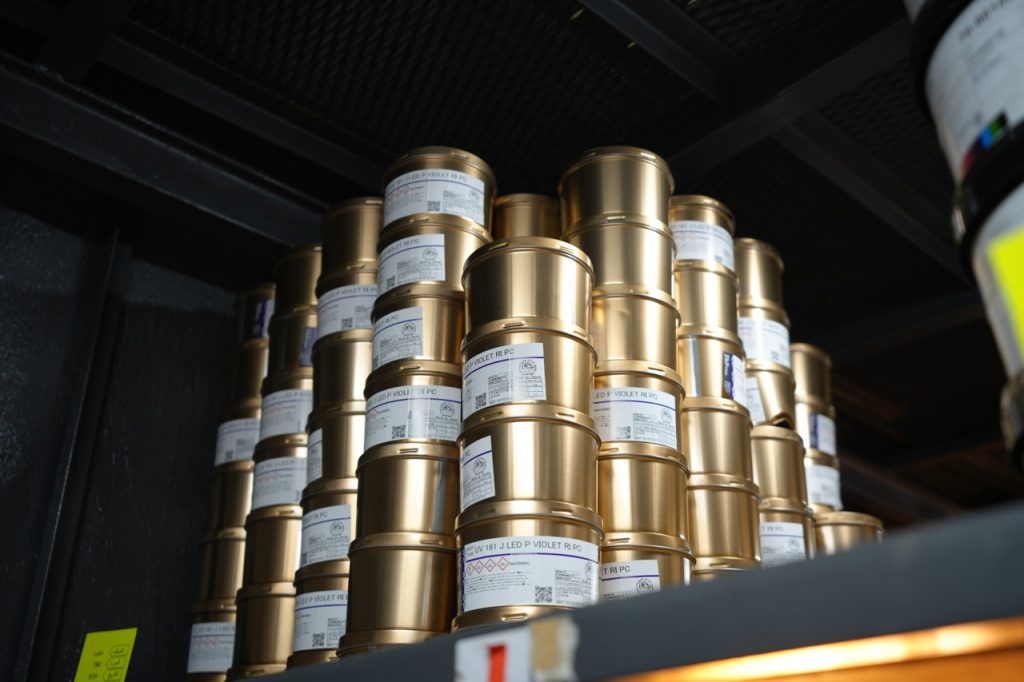
ETALEX has manufactured printed labels in Cairo since 1952. Our detergent and chemical product labels page explains how we choose the face material and adhesive for the container and the contents. This guide covers what to check when you specify labels for detergents, cleaning products and other chemical packs. It is practical guidance, not regulatory advice.
What does a chemical or detergent label have to survive?
Detergent packs are a hard home for a label: the surface is often textured plastic, the contents are aggressive and the pack is handled wet (ETALEX detergents page). Add squeezing, abrasion and a long life under the sink, and a general-purpose label can lift, smudge or become unreadable. Each condition attacks a different part of the label:
- Product drips and splashes. Surfactants, solvents, bleach, acids or alkalis reach the label face and edges, where they can soften inks and creep under the edge into the adhesive.
- Water and wet hands. Packs are used in kitchens, bathrooms and laundries. Paper labels are not waterproof (ETALEX cosmetics page).
- The container surface. HDPE and PP, common in detergent bottles and jerrycans, are low-energy surfaces that labels remove from more easily than glass or PET (Avery Dennison, film facestock guide). Texture leaves the adhesive less to grip.
- Squeezing. A stiff label can wrinkle or lift on a squeezable bottle, which needs a conformable film (Avery Dennison, film facestock guide).
- Abrasion. Bottles rub against each other, cartons and shelves, and unprotected print can scuff.
- Required life. Instructions and safety text should stay readable until the pack is used up, which may be months.
Write these conditions down before you ask for a quote; they decide the construction more than the artwork does.
Which label materials resist moisture and chemicals?
Film facestocks are the usual starting point where a label meets water or chemicals. Within film, PE is the most conformable and suits squeezable bottles, while PP suits rigid containers (Avery Dennison, film facestock guide). Confirm the choice by testing with your own product.
Polypropylene (PP) labels are waterproof and oil resistant (ETALEX cosmetics page). But waterproof is not the same as chemical resistant: a film that shrugs off water may still lose its print to a solvent-based or strongly alkaline product. The protective layer over the print matters as much as the film.
Options to discuss with your label printer:
- Overlaminate. A clear film over the print adds body and resists scuffing, oils and chemicals (Avery Dennison, overlaminates brochure). Check the extra thickness suits a squeezable bottle.
- Varnish. Ink makers offer UV varnishes in high-rub and chemical-resistant versions (Flint Group). A varnish is a thin layer, so confirm its resistance against your product rather than assume it.
- Inks. Ask whether the inks suit the film and contact with your product. Our guide to label printing methods compares the main processes.
Our guide to self-adhesive label materials explains facestock, adhesive and liner, and our cosmetic and perfume labels guide compares varnish and lamination.
How do you choose an adhesive for chemical containers?
Choose the adhesive for the container surface first, then for what the product and environment will do to it. Low-energy plastics, textured surfaces and squeezable bottles each need a suitable adhesive, and it must keep its grip if product or water reaches the label edge.
Avery Dennison’s adhesive guide describes the main trade-offs:
- Solvent acrylic offers water, heat and chemical resistance.
- Hot-melt rubber gives tack on the broadest range of surfaces and good adhesion on rough or contaminated surfaces.
- Emulsion acrylic suits high-speed conversion and general use.
On the line, keep the bottle clean and dry where the label goes on, because filling residue weakens the bond. And note where drips run: a label below a spout meets more product than one on the opposite face. Our self-adhesive labels page shows the label types we supply.
How should you test chemical and detergent labels?
Test the finished label on the real container with the real product; a data sheet describes only standard conditions. Apply labels on your line, let the adhesive settle, then expose labelled packs to drips, immersion, rubbing and squeezing.
FINAT, the European label association, publishes standard test methods for self-adhesive materials. They include FTM 16 and FTM 17 for chemical resistance (spot and immersion), FTM 1 and FTM 2 for peel adhesion and FTM 9 for loop tack (FINAT). Asking which method a supplier’s figures use makes results comparable.
A useful test result names the method, the chemical or product, the exposure time and temperature, and what “pass” meant, for example “print legible and no edge lift after immersion”. The bare phrase “chemical resistant” tells you little. Use the table to plan a trial with your label printer.
| Condition | What can go wrong | Test to ask for or run |
|---|---|---|
| Product drips on the label face | Ink softens, smears or comes off; face goes dull | Spot test with your own product, then rub the area and inspect the print |
| Product or water at the label edge | Adhesive softens; edge lifts or label slides | Immersion test of labelled packs in your product and in water; check edges afterwards |
| Squeezable bottle | Wrinkling or lifting where the bottle flexes | Squeeze labelled bottles repeatedly; inspect for wrinkles and lift |
| Transport and shelf abrasion | Scuffed print, unreadable safety text | Rub test on labelled packs, packed and shipped as in real distribution |
| Low-energy or textured plastic (HDPE, PP) | Weak adhesion, especially at first | Peel and tack check on the exact container after the adhesive has settled |
| Long storage | Gradual edge lift; fading | Store labelled, filled packs in warm and humid conditions and re-check at intervals you agree with your supplier |
Sources: FINAT test methods; Avery Dennison adhesive guide and film facestock guide; ETALEX detergents and cosmetics pages (see Sources).
What about hazard text, GHS and CLP?
Many cleaning and chemical products must carry hazard information that has to last as long as the label. The UN Globally Harmonized System (GHS) sets out hazard pictograms, signal words and hazard statements, but countries adopt it in different ways and at different times, so requirements vary by market.
In the EU, the CLP Regulation (Regulation (EC) No 1272/2008) incorporates the GHS criteria into EU law (recitals 5 to 8). Its Article 31(1) requires labels to be firmly affixed to one or more surfaces of the packaging immediately containing the substance or mixture, and Article 31(3) requires the label elements to be clearly and indelibly marked and to stand out clearly from the background. Regulation (EU) 2024/2865 has since amended Article 31, adding provisions on label formatting, fold-out labels and digital labels, with application dates in 2026 and 2027, so always work from the current consolidated text. Requirements in other markets, including Egypt and the Gulf, may differ. Confirm what applies to each product and market with your regulatory or compliance advisers.
For label buyers, three practical points follow:
- Durability matters. If the print dissolves or the label falls off, the hazard information is lost. Test the legibility of safety text, not just adhesion.
- Space is often short. Small packs with several languages can run out of room. Plan the text early, because the label size, the type size and the languages all compete for the same space. Our guide to labels for small bottles covers small containers.
- Content comes from you. Your regulatory team sets the hazard wording. Send it with your specification so the label size and layout can be planned around it.
What should you tell your label manufacturer?
Describe the container, the product and every condition the labelled pack meets, from filling to the end of use. The more precisely you describe them, the better the proposal you can test.
- Container type and material (HDPE, PP, PET or other), shape, and whether it is squeezed.
- Surface finish: smooth, textured or coated, and any residue from filling.
- The product, and whether it contains solvents, bleach, acids or alkalis. A safety data sheet helps.
- Where drips will run, and whether the label sits near the spout or handle.
- Storage and use: kitchen, bathroom, laundry, warehouse or outdoors, and expected shelf life.
- Hazard and safety text, languages and any market requirements your team has identified.
- Label size, quantity, number of versions and preferred finish.
- Labelling method: by hand or machine, and the applicator used.
ETALEX prints in-house with letterpress (flat and rotary), rotary offset, flexography, silk screen and digital printing, with hot stamping and embossing for finishing. See our label printing technologies. Our label quote checklist covers the full specification, and how to choose a label manufacturer explains what to ask any supplier. For oil containers, see motor oil and lubricant labels.
Frequently asked questions
Why do labels peel off detergent bottles? Usually because the adhesive does not suit the container or conditions. Detergent bottles are often HDPE or PP, which labels grip less easily, and may be textured or squeezed. Residue at labelling and drips at the edge weaken the bond further. Specify the adhesive for the exact container and test with your product.
Are paper labels suitable for detergent and chemical products? Paper labels are not waterproof, so they suit packs that stay dry. For packs handled wet or exposed to drips, consider a film facestock with an overlaminate or varnish, and test with your own product: waterproof film does not automatically resist every chemical.
What does “chemical resistant label” actually mean? It has no single definition. A label may resist one chemical but not another, or drips but not immersion. Ask which test method, chemical, exposure time and temperature were used and what counted as a pass, then run your own trial.
Does my detergent label need to follow GHS or CLP? It depends on the product’s classification and the markets where it is sold. GHS is adopted differently by different countries; in the EU it is applied through CLP. Confirm the requirements for each product and market with your regulatory or compliance advisers.
Sources
- ETALEX, Detergents and Cleaning Supplies page. https://www.etalex.com/detergents-cleaning/. Accessed 5 October 2026. Used for: textured plastic surface, aggressive contents, handled wet; face material and adhesive chosen for the container and the contents; (paraphrased from the page’s current copy).
- ETALEX, Cosmetics page. https://www.etalex.com/cosmetics/. Accessed 5 October 2026. Used for: polypropylene labels waterproof and oil resistant; paper labels not waterproof and suited to packs kept dry.
- ETALEX, Home and About pages. https://www.etalex.com/ and https://www.etalex.com/about/. Accessed 5 October 2026. Used for: Cairo since 1952; in-house processes (letterpress flat and rotary, rotary offset, flexography, silk screen, digital printing, hot stamping; embossed labels).
- Avery Dennison (Ophelia Gallagher), “How to Choose the Right Film Facestock” (whitepaper, PDF). https://www.averydennison.com/content/dam/averydennison/lpm/ap/en_cn/doc/resourcecenter/HowtoChoosetheRightFilmFacestock.pdf. Accessed 5 October 2026. Used for: HDPE, PP and LDPE as low-energy substrates; squeezable containers need conformable film; PE most conformable, PP for rigid containers; film choice by conditions.
- Avery Dennison, “Adhesive Technologies: Labels + Packaging Technical Guide, Europe 2020” (PDF). https://label.averydennison.com/content/dam/averydennison/lpm-responsive/europe/english/documents/product-overviews/product/adhesives/lpm-eu-technical%20guide-adhesive%20technologies-2020-web.pdf. Accessed 5 October 2026. Used for: solvent acrylic water, heat and chemical resistance; hot-melt rubber tack on broad range and rough or contaminated surfaces; emulsion acrylic for high-speed conversion; testing the complete construction.
- Avery Dennison, “Overlaminates: Films with Technology. Products with Purpose.” (North America brochure, PDF). https://label.averydennison.com/content/dam/averydennison/lpm-responsive/na/doc/product-overviews/product/overlaminates/br-overlaminates.pdf. Accessed 5 October 2026. Used for: overlaminates add thickness and body and resist scuffing, oils and chemicals.
- Flint Group Narrow Web, “UV Varnishes: high performance products for a wide range of print processes” (product brochure, PDF). https://www.flintgrp.com/media/osdfisx2/uv_varnishes_ver2_us.pdf. Accessed 5 October 2026. Used for: hi-rub and product-resistant UV varnishes; high chemical resistance versions.
- FINAT, “FINAT Test Methods”. https://www.finat.com/knowledge/finat-test-methods. Accessed 5 October 2026. Used for: FTM 1 and 2 (peel adhesion), FTM 9 (loop tack), FTM 16 and 17 (chemical resistance, spot and immersion).
- Regulation (EC) No 1272/2008 of the European Parliament and of the Council of 16 December 2008 on classification, labelling and packaging of substances and mixtures (CLP), Official Journal L 353, 31.12.2008. https://eur-lex.europa.eu/eli/reg/2008/1272/oj. Official text read 6 October 2026 (Publications Office copy of CELEX 32008R1272). Used for: recitals (5) to (8), incorporation of the GHS criteria; Article 31(1), labels firmly affixed to the packaging immediately containing the substance or mixture; Article 31(3), label elements clearly and indelibly marked and standing out clearly from the background.
- Regulation (EU) 2024/2865 of the European Parliament and of the Council of 23 October 2024 amending Regulation (EC) No 1272/2008, Official Journal L series, 20.11.2024. https://eur-lex.europa.eu/eli/reg/2024/2865/oj. Official text read 6 October 2026 (Publications Office copy of CELEX 32024R2865). Used for: Article 1, point (15), amendments to CLP Article 31 (fold-out labels, digital-label data carrier, formatting under Annex I section 1.2.1); Article 2(2) and (3), application from 1 July 2026 and 1 January 2027.
Written by
Etalex Team
Content & Editorial Team
Practical guidance on label printing, finishing, materials and packaging, informed by Etalex's manufacturing experience in Cairo since 1952.
Related guides
Industry Insights
Motor Oil and Lubricant Labels: Oil Resistance and Adhesion on Plastic Containers
Key answer Motor oil labels fail mainly at the edges: plastic oil containers are hard surfaces for adhesives to grip, and oil on the pack…
Industry Insights
Beverage and Water Bottle Labels: Wet Conditions, Condensation and Adhesion
Key answer Labels fail on beverage bottles mainly because cold bottles collect condensation, and a self-adhesive label will not stick to water. Keep the bottle…
Industry Insights
Food Packaging Labels: Materials, Moisture and Compliance Questions to Ask
Key answer A food packaging label has to stick and stay legible through filling, chilling, freezing, humidity and handling, and it must not compromise the…
Talk to the Etalex team
Ready to discuss your labels?
Send the size, quantity, material, finish and container, with artwork if you have it. Our team in Cairo replies during working hours, Sunday to Thursday.