Industrial Labels: Durability Requirements and Material Options
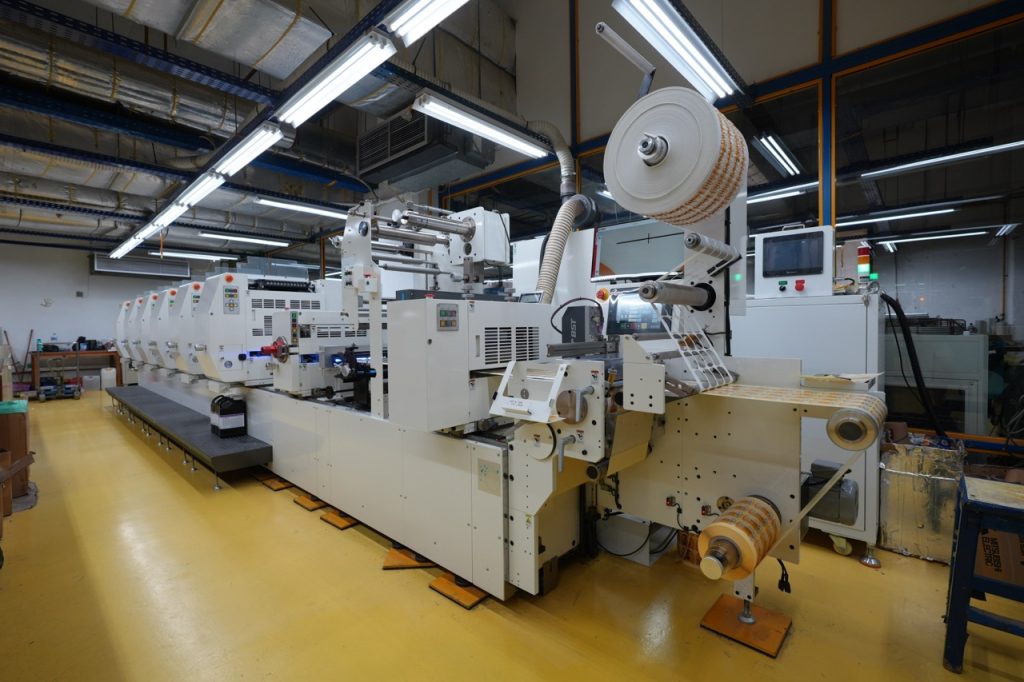
ETALEX has manufactured printed labels in Cairo since 1952. Our industrial and textile labels page makes the starting point clear: industrial products such as televisions, home commodities and machinery need labels with adhesives and designs suited to how the product is used and handled. This guide covers durability requirements, material options, barcodes and what to tell any label supplier.
What makes an industrial label different from a packaging label?
A packaging label usually needs to last until the pack is opened; an industrial label often has to last as long as the product. Avery Dennison’s durable labelling portfolio puts it simply: “When it comes to durable goods, labels are for life.” It names the challenges as harsh chemicals, difficult surfaces, temperature and environmental variation, and wear and tear.
The information matters more too. Rating labels, serial numbers, barcodes and warnings are used for identification, service, traceability and safety, and HERMA, a German label maker, notes that such labels “must remain legible for many years”. The question is not only “will it stick?” but “will every line and code still be readable at the end of the product’s life?”
Which operating conditions should you map first?
List every condition the label meets, from the factory line to the end of service.
- Abrasion. Rubbing in assembly, transport, cleaning and use. It scuffs the print first.
- Oils, greases and chemicals. Lubricants, coolants, solvents and cleaning agents can soften the print, facestock or adhesive. HERMA lists resistance to acids, alkalis, solvents, oils and greases among the requirements for machinery and electronics labels.
- Moisture. Humidity, condensation, washdown or rain. Water at the label edge works on the adhesive.
- Heat and cold. Motors, electronics, cold stores, outdoor winters. Material data separate the minimum application temperature from the service temperature range, so ask about both.
- Sunlight and UV. Colours can fade and some films become brittle.
- The surface. Painted or powder-coated parts, textured or low-energy plastics, curves and dusty or oily parts all change the adhesive choice. HERMA describes adhesive strength “keyed to the given surface, such as highly curved, rough, dusty or oily”.
Write down the expected service life too: the warranty period and the life of the machine are different specifications.
Which label materials suit industrial conditions?
A self-adhesive label is a system: facestock, print, any protective layer, and adhesive. HERMA offers a useful rule of thumb: paper or polypropylene (PP) is “the ideal choice for many applications”, but high temperatures, moisture, chemicals or mechanical stress can push conventional labels past their limits. For those cases it describes polyester (PET) films as scratch and abrasion resistant, dimensionally stable across temperatures, and resistant to moisture and many chemicals.
Avery Dennison’s durables range shows the same pattern: PET films with different adhesives, an outdoor PVC film and clear overlaminates, each rated separately for surface types and for water, chemical and outdoor resistance. The adhesive and protection are chosen with the facestock, not after it. See our guides to self-adhesive label materials and waterproof, freezer and chemical-resistant labels for more depth.
Some equipment is marked with metal plates, aluminium labels or tags instead. These are separate product types outside the scope of this guide; if your specification calls for one, ask suppliers directly whether they make that format.
| Condition | What can go wrong | Material or construction question to ask |
|---|---|---|
| Abrasion and handling | Print scuffs; text and codes become unreadable | Is the print protected by an overlaminate or a rub-resistant varnish? Is the facestock abrasion resistant? |
| Oils, coolants, cleaning agents | Ink smears; facestock or adhesive softens; edges lift | Has the full construction been tested with our fluids, on the label face and at the edge? |
| Moisture, washdown, condensation | Paper weakens; adhesive releases at the edges | Is a film facestock needed? Is the adhesive rated for water exposure? |
| Heat near motors or electronics | Adhesive softens or ages; film shrinks or curls | What is the service temperature range, and what is the minimum application temperature? |
| Sunlight and UV | Colours fade; film becomes brittle | Is the construction intended for outdoor exposure? Is there UV-resistance data? |
| Difficult surfaces | Weak grip on textured, low-energy, painted or curved parts | Which adhesive suits our exact surface, and has it been tried on a production part? |
Sources: HERMA; Avery Dennison durables portfolio (see Sources).
How does the print method affect durability?
The ink must survive the same conditions as the facestock. HERMA treats thermal transfer printability, with “excellent protection against smudging and scratching”, as part of the specification of its durable labels.
Decide early what is printed at the label press and what is added later. Fixed text, logos and warnings are printed with the label; serial numbers, dates and many barcodes are often added afterwards, for example by thermal transfer at your own line. Then the ribbon and label surface must be compatible and just as durable. GS1 draws the same line between static and dynamic (variable data) printing.
ETALEX prints in-house with letterpress (flat and rotary), rotary offset, flexography, silk screen and digital printing, with hot stamping and embossing for finishing. Our label printing methods guide and printing technologies page compare these processes. Ask any supplier which process and protective finish suit your conditions, and why.
How do you keep barcodes scannable for the product’s life?
A barcode that reads at the end of the line can still fail in the field. GS1’s playbook for 2D barcode printing says print quality should be evaluated not only right after printing but also after “abrasion, compression, moisture, temperature variation, and package flexing”. Three points matter most:
- Contrast. Scanners detect the difference in light reflectance between dark and light areas. Many scanners use red light, so GS1 warns that red, orange, yellow and some metallic inks “may appear effectively invisible to scanners” as bar colours. It recommends black or dark blue on white and matt rather than highly reflective surfaces, so glossy, chrome or clear constructions deserve a scan test.
- Quiet zone. The clear margin around a barcode lets the scanner find where the symbol begins and ends. GS1 calls insufficient quiet zones “one of the most common causes of scan failure” for 2D barcodes; keep them free of text and graphics through every artwork revision, die-cutting and finishing. On a small label, check that edges and borders do not cut into them.
- Print durability. Protect the code like the text, and avoid placing it in “areas subject to abrasion or damage”, as GS1 advises.
GS1 refers to its General Specifications for minimum print quality grades and to ISO/IEC 15415 for 2D barcode print quality verification, measured with an instrument conforming to ISO/IEC 15426-2. Ask how print quality will be verified, on which material, and whether labels will be rechecked after durability testing.
How should you test industrial labels before approving them?
Test the finished label, printed and protected as supplied, on real production parts, under the conditions you mapped. FINAT, the European self-adhesive label association, publishes test methods that give buyers and suppliers a shared language:
- Adhesion: peel adhesion (FTM 1 and 2), loop tack (FTM 9) and resistance to shear (FTM 8).
- Ageing and environment: accelerated ageing (FTM 5), resistance to ultraviolet light (FTM 6) and low temperature adhesion (FTM 13).
- Fluids: chemical resistance by spot (FTM 16) or immersion (FTM 17).
- Print: ink adhesion (FTM 21 and 22) and ink rub for UV-printed labels (FTM 27).
ASTM D5264 describes a rub test for printed materials, including labels. Some end products also need labels recognised under UL 969, the standard for marking and labelling systems. UL Solutions explains that label stocks, adhesives, overlaminates and inks are evaluated together after exposure to conditions such as humidity, water, heat, sunlight or chemicals, then checked for curling, shrinkage, loss of adhesion and legibility. If your product standard requires this, ask for documentation of the exact construction offered.
Agree in advance which tests, on which parts, and what counts as a pass.
What should you tell your label supplier?
“A durable label” is not a specification. Give the supplier the facts that decide the construction:
- The product, label position, and surface material and finish.
- How the label is applied (hand or machine) and the temperature at application.
- Every service condition: abrasion, named oils, chemicals and cleaners, moisture, heat, cold, outdoor exposure.
- How long the label must stay attached and readable.
- What is printed at the press and what is added later (serial numbers, dates, barcodes), and the printer and ribbon used.
- Barcode type, size and who scans it.
- Any product standard or customer specification the label must meet.
- Label size, quantity, number of versions and finish.
Our label quote checklist covers the full specification, and our guide on how to choose a label manufacturer lists the checks to run on any supplier. See also chemical and detergent labels, motor oil and lubricant labels, our self-adhesive labels page and all the industries we serve.
Frequently asked questions
What is an industrial label? A label on equipment, appliances, machinery or components rather than a consumer pack, typically carrying ratings, serial numbers, barcodes or warnings that must stay readable for the product’s working life.
What is the most durable material for industrial labels? It depends on the conditions. Polyester films are widely used where abrasion, moisture, heat or chemicals are expected, often with an overlaminate or varnish, but the adhesive must suit the surface, so choose and test the construction as a whole.
Why do barcodes on industrial labels stop scanning? Usually the print has been rubbed or attacked by fluids, the contrast was too low from the start (red bars, a reflective surface), or something intrudes into the quiet zone. Scan again after durability testing, not only at the line.
How should I test an industrial label? Apply the finished label to real parts and expose them to the abrasion, fluids, moisture, temperatures and light of service. FINAT methods cover adhesion, ageing, UV and chemical resistance; ASTM D5264 covers rub resistance.
Sources
- ETALEX, Industrial and Textiles page. https://www.etalex.com/industrial-textiles/. Accessed 7 October 2026 (live page). Used for: industrial goods such as televisions, home commodities and machinery need labels with adhesives and designs suited to the product.
- ETALEX, Home and About pages. https://www.etalex.com/ and https://www.etalex.com/about/. Accessed 7 October 2026 (live pages). Used for: Cairo since 1952; in-house letterpress (flat and rotary), rotary offset, flexography, silk screen, digital printing and hot stamping; embossed labels.
- Avery Dennison, “Select Solutions: Avery Dennison Performance Portfolio, Durable Labelling” (South Asia, 2019, PDF). https://label.averydennison.com/content/dam/averydennison/lpm-responsive/asia-pacific/en-sa/documents/products/select-solutions/select-solutions-portfolio/po/sthasia/po-select-solutions-durables-gpp-sthasia-2019-1.pdf. Accessed 7 October 2026. Used for: “labels are for life”; challenges of durable goods (chemicals, substrates, temperature and environmental variation, wear and tear); applications (rating, barcode, warranty, warning and identification labels); PET, outdoor PVC and overlaminate constructions rated by surface type and by water, chemical and outdoor resistance; minimum application temperature listed separately from the service temperature range.
- HERMA, “HERMA PET films”. https://www.herma.com/material/products/film-based-label-materials/herma-pet-films/. Accessed 7 October 2026. Used for: paper or PP ideal for many applications but limited by high temperatures, moisture, chemicals or mechanical stress; PET scratch and abrasion resistant, dimensionally stable, resistant to moisture and many chemicals; used on machinery, equipment and electronic components; labels for identification, traceability and safety must remain legible for many years.
- HERMA, “Automotive and electronics industries”. https://www.herma.com/label/industries/automotive-and-electronics-industries/. Accessed 7 October 2026. Used for: abrasion- and tear-resistant materials such as polyester; adhesive strength keyed to curved, rough, dusty or oily surfaces; resistance to acids, alkalis, solvents, oils and greases, moisture and UV; thermal transfer printability with protection against smudging and scratching.
- GS1, “GS1 2D Barcode Playbook for Creation and Printing”, Release 1.0.1, June 2026. https://ref.gs1.org/sme-guidance/2d-barcode-creation-and-printing-playbook/1.0.1/. Accessed 7 October 2026. Used for: substrate and print method affect contrast and durability; barcodes must remain scannable after handling, abrasion, moisture and temperature variation; quiet zones (definition, common cause of scan failure, kept free of text and graphics, checked after finishing); red illumination and colours to avoid; dark on light, matt surfaces; avoid areas subject to abrasion; static versus dynamic printing; reference to GS1 General Specifications section 5.12, ISO/IEC 15415 and ISO/IEC 15426-2.
- FINAT, “FINAT Test Methods”. https://www.finat.com/knowledge/finat-test-methods. Accessed 7 October 2026. Used for: names and numbers of FTM 1, 2, 5, 6, 8, 9, 13, 16, 17, 21, 22 and 27.
- ASTM International, D5264-98(2019), “Standard Practice for Abrasion Resistance of Printed Materials by the Sutherland Rub Tester”. https://store.astm.org/d5264-98r19.html. Accessed 7 October 2026. Used for: procedure for abrasion resistance of printed materials; applicable to labels.
- UL Solutions, “Marking and Labeling Systems Program”. https://www.ul.com/services/marking-and-labeling-systems-program. Accessed 7 October 2026. Used for: labels tested to ANSI/UL 969; label stocks, laminating adhesives, overlaminates and inks evaluated; conditioning for humidity, water, elevated temperature, sunlight or chemicals; examination for curling, wrinkling, shrinkage, loss of adhesion, legibility and resistance to defacement.
Written by
Etalex Team
Content & Editorial Team
Practical guidance on label printing, finishing, materials and packaging, informed by Etalex's manufacturing experience in Cairo since 1952.
Related guides
Guides
Troubleshooting Label Adhesion: Lifting, Curling and Wrinkling
Key answer Most label adhesion problems come from a mismatch between the label construction and real conditions at your line: container material and shape, surface…

Guides
Label Printing Cost: What Drives the Price
Key answer Label printing cost is set by your specification, not by a list price. Quantity and run length, the number of designs, size and…
Guides
Storing Labels: Temperature, Humidity and Shelf Life
Key answer Good label storage means keeping rolls sealed in their original packaging, in a clean, dry, dark place at moderate room temperature and humidity,…
Talk to the Etalex team
Ready to discuss your labels?
Send the size, quantity, material, finish and container, with artwork if you have it. Our team in Cairo replies during working hours, Sunday to Thursday.