Waterproof, Freezer and Chemical-Resistant Labels: How to Choose
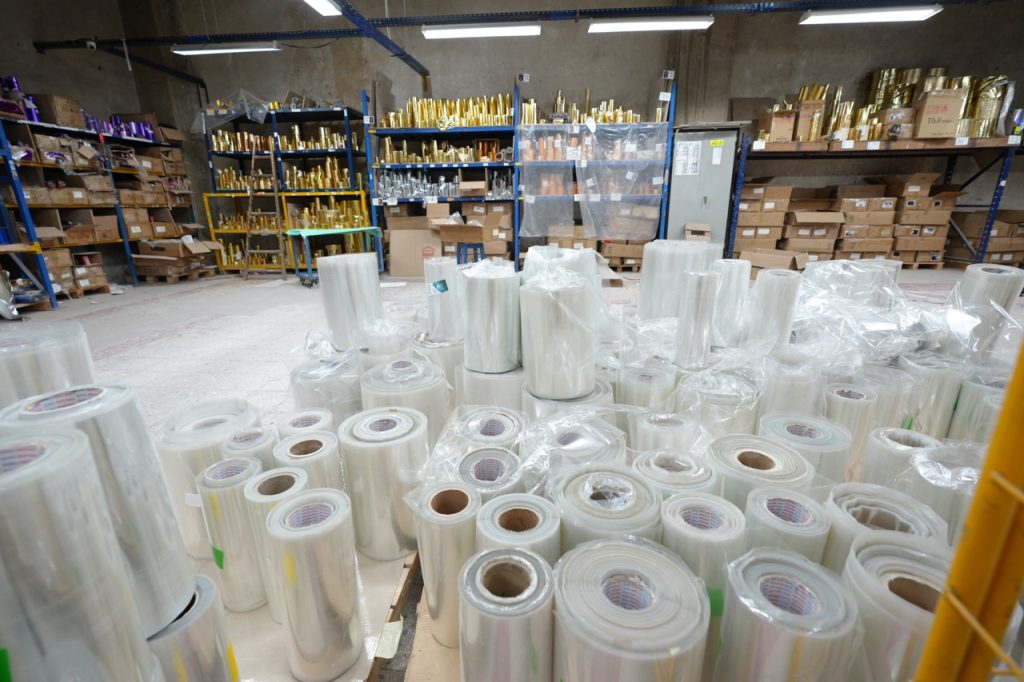
ETALEX has manufactured printed labels in Cairo since 1952. As our food and beverage labels page says, heat, moisture and cold affect a label’s performance and longevity, and storage conditions define the material. This guide covers the selection factors shared by food and drink, detergent and cleaning products and motor oils and lubricants, and what to ask any label supplier.
What do “waterproof”, “freezer” and “chemical-resistant” actually mean?
They are shorthand for conditions, not product categories. A label has layers: a facestock (paper or film) carrying the print, often a varnish or overlaminate on top, and an adhesive underneath, supplied on a release liner. Each condition attacks a different layer:
- Water soaks and weakens paper, and can reach the adhesive at the label edge.
- Cold changes how the adhesive behaves, both when the label is applied and while it is stored.
- Oils and chemicals can soften inks and coatings on the face and creep under the edge into the adhesive.
So a film that shrugs off water may still lose its print to a solvent. Ask which layer each claim refers to, and under which conditions it was measured.
Which conditions should you define first?
Describe the whole life of the labelled pack, from filling line to end of use:
- Water: splashes, wet hands, ice buckets, washing or immersion.
- Condensation: whether chilled packs are labelled or handled damp.
- Temperature at labelling: ambient, chilled or frozen packs.
- Temperature in storage: chiller, freezer, hot store, or cycles between them.
- Oils and chemicals: the product, plus anything on hands or surfaces.
- The container: material, finish, shape and whether it is squeezed.
- Handling and life: rubbing in cartons and how long text must stay readable.
How do you choose labels for wet conditions and condensation?
Start with the facestock. Paper absorbs water, so packs that are handled wet usually need a film facestock or a protected paper. Avery Dennison’s overlaminates brochure describes polypropylene and polyester films as providing excellent chemical, acid and moisture resistance.
Condensation is a separate problem, because it affects the bond rather than the face. A chilled pack in warm air is soon wet, and a label applied to it may never grip. HERMA, a German label maker, notes that most labels “simply fall off” surfaces that are icy or damp from condensation, and that strong initial tack is essential there. Some adhesives are designed for such surfaces: Avery Dennison, for example, describes one of its wine and spirits adhesives (S2047N) as having “excellent ice bucket resistance”.
Label dry packs where you can; if labelling happens in a cold, damp area, tell your supplier. Our guides to beverage and water bottle labels and food packaging labels cover these conditions in more detail.
What is the difference between application and service temperature?
This distinction matters most for freezer labels. Avery Dennison’s adhesive guide defines the minimum application temperature as the lowest temperature recommended during labelling, and service temperature as the range for storing a label that has already been applied. Both need to be considered.
Most of its adhesives, the guide says, are designed for ambient conditions with a minimum application temperature of +5°C, while once in service its regular adhesives can survive -40°C to +80°C. So a standard label applied at room temperature may survive a freezer, while the same label applied to a frozen pack may not stick. As examples of products built for colder labelling, Avery Dennison lists a deep-freeze hot-melt rubber adhesive (C2075N) with a minimum application temperature of -25°C, and HERMA states that its deep-freeze adhesive can be applied at -25°C and, once bonded, withstands -60°C to +60°C. These figures describe those manufacturers’ products only; your label needs its own data and trial.
Adhesives are often grouped into three general categories:
- Permanent (general purpose): for ambient labelling; may suit cold storage if labelled warm.
- Freezer or deep-freeze: formulated to grab at low application temperatures.
- All-temperature: for a wide range of application and service conditions.
Avery Dennison adds that tack falls as application temperature drops, and that adhesives need dwell time to reach full adhesion, which it puts at 2 to 24 hours depending on conditions. Check labelled packs after that time, not only at the line.
How do oils and chemicals change the choice?
Oil and chemicals act on both sides of the label. On the container, Avery Dennison’s adhesive guide places “dusty and oil contaminated surfaces” among the most challenging to label, and describes hot-melt rubber adhesives as adhering well on rough or contaminated surfaces. On the face, products can soften inks and coatings, so print protection matters as much as the film. The same guide describes solvent acrylic adhesives as offering exceptional water, heat and chemical resistance. Test with your actual product, not a generic chemical. Our guides to chemical and detergent labels and motor oil and lubricant labels cover these markets in depth.
How do you match facestock and adhesive to the container?
Start with surface energy. Avery Dennison explains that polar surfaces such as PET and glass have high surface energy and “are easier to stick to”, while apolar surfaces such as PVC and HDPE have low surface energy, so “adhesives don’t stick as easily”. Its film facestock guide adds that greasy, dry or hot surfaces do not change the facestock choice but “directly affect the adhesives used”.
Then the shape. The facestock guide says any container that is squeezable, has a “waist” or is egg-shaped “requires conformable films”, with PE the most conformable. Check that conformability after cold storage too.
Finally, the liner and application: the liner carries the label through printing and dispensing, so tell your supplier how labels are applied, with which applicator, label direction and core size. Our guide to self-adhesive label materials explains facestock, adhesive and liner in more depth, and our self-adhesive labels page shows the label types we supply.
Do you need an overlaminate or varnish?
Where labels are rubbed, wiped or splashed, protect the print. Avery Dennison’s overlaminates brochure says self-wound overlaminates add thickness and body to a label and strength to prevent tearing, and lists overlaminates offering oil, chemical and scuff resistance. A varnish is a thinner layer, which can suit squeezable packs, but its resistance should be confirmed against your product rather than assumed.
Print durability also covers codes added at your line, which must accept your ink or ribbon. HERMA notes for its seawater-resistant labels that the toner, ink or thermal transfer ribbon must meet the requirement too, not only the label material. Our guide to label printing methods compares the main processes. For labels on equipment and machinery, our guide to industrial labels covers abrasion, readability and barcode durability.
How should you test labels on real packs?
Data sheets describe standard conditions; your packs meet real ones. Apply labels on your own line at your real temperatures, then expose labelled packs to their real conditions. FINAT, the European self-adhesive label association, publishes test methods (FTM) that make results comparable; the table names the relevant ones. A useful result names the method, the product, the exposure time and temperature, and what counted as a pass.
| Condition | What can go wrong | Test to ask for or run |
|---|---|---|
| Labelling cold or frozen packs | Label never grips; falls off later | Apply at your real line temperature; check adhesion after dwell time (low temperature adhesion, FTM 13; loop tack, FTM 9) |
| Freezer or chiller storage | Edges lift; label cracks on curves | Store labelled packs at service temperature, then inspect edges and curves (mandrel hold, FTM 24) |
| Condensation and wet handling | Adhesive weakens; paper softens | Move chilled packs into warm, humid air, handle them wet, then check edges and face |
| Water or product immersion | Edge lift; print loss | Immersion of labelled packs in water and in your product (FTM 17) |
| Oil or chemical splashes | Ink smears; coating dulls | Spot test with your own product, then rub the area (FTM 16) |
| Rubbing in cartons and use | Scuffed print; unreadable text | Ink adhesion and rub tests (FTM 21 or 22; FTM 27), with and without overlaminate or varnish |
| Low-energy or contaminated surface | Weak grip from the start | Peel adhesion on the exact container (FTM 1 or 2), with the surface as it is on your line |
| Long storage | Gradual lift or fading | Recheck stored packs at intervals agreed with your supplier (accelerated ageing, FTM 5) |
Sources: FINAT test methods; Avery Dennison; HERMA (see Sources).
What should you tell your label manufacturer?
Give your supplier the conditions, not just the word “waterproof”.
- Container material, surface finish, shape and whether it is squeezed.
- Pack temperature at the moment of labelling, and whether it is dry or damp.
- Storage and transport temperatures, including freezing, chilling or hot stores.
- Water, condensation, oils or chemicals that reach the label, with a safety data sheet where relevant.
- Required life of the label and the information that must stay readable.
- Any coding added at your line: method, position and coder.
- Labelling method: by hand or machine, and the applicator used.
- Label size, quantity, number of versions and preferred finish.
ETALEX prints in-house with letterpress (flat and rotary), rotary offset, flexography, silk screen and digital printing, with hot stamping and embossing for finishing. See our label printing technologies and all the industries we serve. Our label quote checklist covers the full specification, and how to choose a label manufacturer explains what to ask any supplier.
Frequently asked questions
Is a waterproof label also a freezer label? Not necessarily. “Waterproof” usually describes the facestock and print, while freezer performance depends mainly on the adhesive and the temperature at labelling. A film label can resist water yet fail to grip a frozen pack. Specify both conditions and test labelled packs at your real temperatures.
Can a standard label go in the freezer? Sometimes. Avery Dennison, for example, designs most of its adhesives for ambient labelling, yet says its regular adhesives survive service temperatures down to -40°C. The risk is labelling packs that are already cold, frozen or damp, which can need an adhesive designed for low application temperatures. Trial it on your packs.
Why do labels fall off chilled bottles? Usually because the bottle was cold or wet with condensation when the label went on, so the adhesive never made full contact. Label dry containers where possible, choose an adhesive intended for cold or damp surfaces if not, and check adhesion after dwell time, not only at the line.
What does “chemical resistant” mean on a label? It has no single definition. A label may resist one chemical but not another, or splashes but not immersion. Ask which test method, chemical, exposure time and temperature were used and what counted as a pass, then run your own trial with your product.
Sources
- ETALEX, Food and Beverage page. https://www.etalex.com/food-beverage/. Accessed 7 October 2026 (live page). Used for: Cairo, manufacturers of quality printed labels since 1952; heat, moisture and cold can affect the performance and longevity of a label; label material defined by the storage conditions (paraphrased).
- ETALEX, Detergents and Cleaning Supplies page. https://www.etalex.com/detergents-cleaning/. Accessed 7 October 2026 (live page). Used for: cross-industry context (textured plastic surfaces, aggressive contents, packs handled wet).
- ETALEX, Automotive Oils and Lubricants page. https://www.etalex.com/automotive-lubricants/. Accessed 7 October 2026 (live page). Used for: cross-industry context (packs filled warm, hot stores, oily hands).
- ETALEX, About page (www.etalex.com/about/). Accessed 7 October 2026 (live page). Used for: established 1952; letterpress in flat and rotary, rotary offset, flexography, silk screen, digital printing and hot stamping.
- Avery Dennison, “Adhesive Technologies: Labels + Packaging Technical Guide, Europe 2020” (PDF). https://label.averydennison.com/content/dam/averydennison/lpm-responsive/europe/english/documents/product-overviews/product/adhesives/lpm-eu-technical%20guide-adhesive%20technologies-2020-web.pdf. Accessed 7 October 2026. Used for: application and service temperature both to be considered; most adhesives designed for ambient conditions with minimum application temperature +5°C, regular adhesives survive -40°C to +80°C in service; tack falls with application temperature; removable adhesive permanent at low temperature; C2075N deep-freeze hot-melt rubber, minimum application temperature -25°C; S2047N ice bucket resistance; definitions of minimum application temperature, service temperature and dwell time (2 to 24 hours); PET and glass high surface energy, PVC and HDPE low; dusty and oil contaminated surfaces among the most challenging; hot-melt rubber on rough or contaminated surfaces; solvent acrylic water, heat and chemical resistance.
- Avery Dennison (Ophelia Gallagher), “How to Choose the Right Film Facestock” (whitepaper, PDF). https://www.averydennison.com/content/dam/averydennison/lpm/ap/en_cn/doc/resourcecenter/HowtoChoosetheRightFilmFacestock.pdf. Accessed 7 October 2026. Used for: greasy, dry or hot surfaces affect the adhesive, not the facestock; squeezable, waisted or egg-shaped containers require conformable films; PE the most conformable film.
- Avery Dennison, “Overlaminates: Films with Technology. Products with Purpose.” (North America brochure, PDF). https://label.averydennison.com/content/dam/averydennison/lpm-responsive/na/doc/product-overviews/product/overlaminates/br-overlaminates.pdf. Accessed 7 October 2026. Used for: overlaminates add thickness and body and strength to prevent tearing; overlaminates with oil, chemical and scuff resistance; polypropylene and polyester films with excellent chemical, acid and moisture resistance.
- HERMA, “Deep-freeze labels: secure labelling of frozen products”. https://www.herma.com/label/solutions/foods-and-beverages/deep-freeze-labels-food-trading-sector/. Accessed 7 October 2026. Used for: most labels fall off icy or condensation-damp surfaces; strong tack essential; deep-freeze adhesive applied at -25°C or to cool and moist surfaces; bonded range -60°C to +60°C.
- HERMA, “Seawater resistant labels with BS 5609 certification”. https://www.herma.com/label/products/seawater-resistant-labels/. Accessed 7 October 2026. Used for: toner, ink or thermal transfer ribbon must also meet the durability requirement, not only the label material.
- FINAT, “FINAT Test Methods”. https://www.finat.com/knowledge/finat-test-methods. Accessed 7 October 2026. Used for: names and numbers of FTM 1 and 2 (peel adhesion), FTM 5 (accelerated ageing), FTM 9 (loop tack), FTM 13 (low temperature adhesion), FTM 16 and 17 (chemical resistance, spot and immersion), FTM 21 and 22 (ink adhesion), FTM 24 (mandrel hold), FTM 27 (ink rub test for UV printed labels).
Written by
Etalex Team
Content & Editorial Team
Practical guidance on label printing, finishing, materials and packaging, informed by Etalex's manufacturing experience in Cairo since 1952.
Related guides
Industry Insights
Motor Oil and Lubricant Labels: Oil Resistance and Adhesion on Plastic Containers
Key answer Motor oil labels fail mainly at the edges: plastic oil containers are hard surfaces for adhesives to grip, and oil on the pack…
Industry Insights
Chemical and Detergent Labels: Resistance to Moisture, Chemicals and Handling
Key answer A chemical or detergent label has to stay attached and readable while the product drips on it, the pack is handled wet and…
Industry Insights
Beverage and Water Bottle Labels: Wet Conditions, Condensation and Adhesion
Key answer Labels fail on beverage bottles mainly because cold bottles collect condensation, and a self-adhesive label will not stick to water. Keep the bottle…
Talk to the Etalex team
Ready to discuss your labels?
Send the size, quantity, material, finish and container, with artwork if you have it. Our team in Cairo replies during working hours, Sunday to Thursday.